| ஒத்திசைவு | प्रत्याह्वय | resonance | for nuclear power, gmo, space research, vaccines, s&t+++, the works… | supporter of the use of our brains-consciousness & the indefatigable human spirit | मेरा देश बदल रहा है | (λஸம்ஸ்க்ருதம்.λதமிழ்.λஹிந்தி.λஆங்கிலம்… …λகடந்தகாலம்.λஓளிரும்நிகழ்காலம்.λஜொலிக்கப்போகும்எதிர்காலம்.λகற்பனை.ஒத்திசைவு) சிந்தனை | 🕉️ नमस्ते सदा वत्सले मातृभूमे… 🇮🇳 | “… … இந்தத் தாளம்தான் செய்கைகளில், அசைவுகளில், காரியங்களில் ஒரு ஒத்திசைவை, லயத்தைக் கேட்டு நிற்கிறது…” |
I am well aware of the sad but real & living idea of Bullshit Asymmetry Principle, also known as Brandolini’s Law; this is about the effort & the energy needed to refute misinformation/fakenews is an order of magnitude (at least 10 times) larger than the energy required to create it.
(…for example, may be the over-enthusiastic gent Sri S Krishnan (TSK henceforth) took some half-an-hour to do ‘research’ and ‘format’ his erroneous & egregious X-post presented in the next section, with some 100+ reposts and likes – but I am aware of my readership numbers (a steady 7½) and also the effort needed for this specific rebuttal.
Though I have possessed the basic context-specific data for more than 15 years—which is why I laughed out loud when I first read TSK’s assertion in this round—to distill everything, ensuring that I miss no fact or angle, marshal all the resources, and present a cogent argument, I have already spent about two hours, and it may take another 6–8 hours** to write this post…)
…see the asymmetry? Bullshit is easy-peasy! But to methodically and clinically take it apart – AND communicate it in a clear, scholarly language is oh so difficult!
…and then, there is this question of ‘in which language I am going to write.’ I chose English as a medium, as it is by default, has more scholarly possibilities and also better readership than 4 or so regular readers of the occasional columns/posts here at Othisaivu. So, here’s hoping some 10 readers would read this labour of jobless-love.
But. Why rebut at all? Why can’t I ignore this as some pure Noise from someone (TSK here) who admittedly has valiantly fought with Dravidoids and Tamil Supremacists rather frequently? One reason is that, in Tamil pop or even ‘serious’ tech/historical discussions – very rarely do we encounter really scholarly and evidence based takes – and I personally want to set an example of how it can be done.
(of course, I am merely a serious student of histories among many other interests, so correctives are welcome – and suggestions to improve the takes in the post would be acknowledged with thanks, though I don’t much care about unreasonable/dravidoid brickbats anyway)
The main reason:
I hold my fellow Bharatiya Conservatives (contrary to rather ‘popular’ myths – far from being all regressive – many of them are briliantly progressive too, in fact many of them are more scholarly, deep, tech-savvy & amenable to reason than their detractors) to MUCH HIGHER standards than what I would do to, say naturally faffing Left-Liberal public intellectuals, with their self-declared progressiveness, erudition and scientific-temper, whatever the fuck they mean by those buzzwords in their own dick-tionaries…
Thanks!
Anyway…
(I have taken the effort to do all these scaffolding & structuring because I want this write-up/rebuttal as a model of what I propose to do henceforth, in such engagements… of course, therefore it is very loooong – some 5000 words – along with a skeletal treatment some adjacent claims/diversions)
2
Though for some historical reasons (actually a similar one: I had the temertity to correct some absolutely ridiculous claims of TSK earlier) I have been blocked by the gent, and occasionally I get sent some pointers by friendly circles – and let me say how I got these of gems of TSK are not too very relevant.
Here is the main claim by TSK:
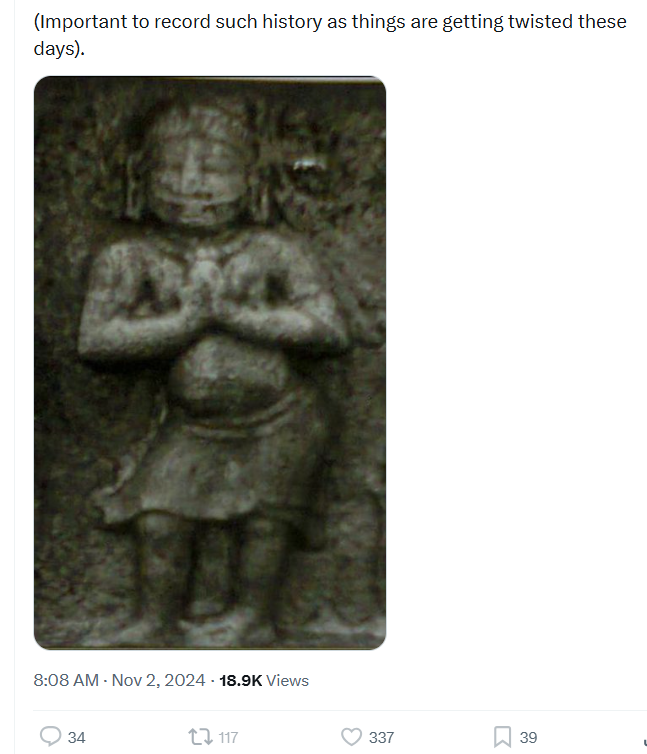
… in which thread, he makes a few random claims – but the the main one is: KT was from a Brahmin lineage.
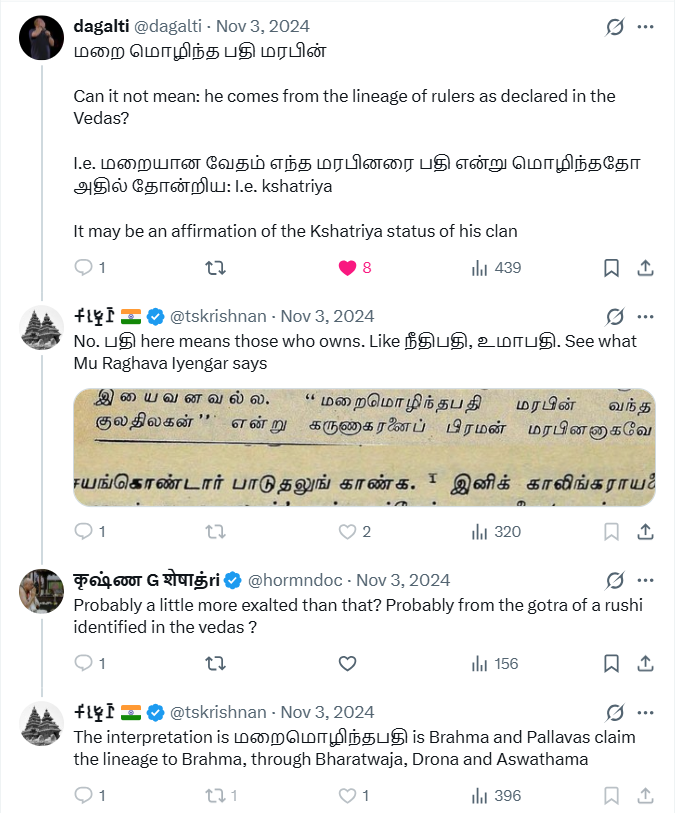
Subsequently when this handle @dagalti asks a relevant question about TSK’s vehement assertion (not that the handle quoted any additional reference), by expanding on and annotating the verses quoted from Kaliṅkattupparaṇi, TSK stonewalls and brings in a fragment of analysis by Sri Mu Raghava Iyengar.
In the big picture of course, I am seriously convinced that these varṇa and jāti classifications are moot/academic points, all are and were Sanatana Dharmics of various extractions – avarnas & savarnas being narrow & divisive classifications – and am responding only to the uncalled-for vehemence of the claim because facts have to be part of any bharatiyata involved discourse. (and um, even otherwise!)
…and then goes on to invent and allude various other interpretations etc etc.
My short response to TSK’s claim:
(…of course, pop-historianships are not at all bad & outlandish per se, and I do agree that TSK has the potential to be a scholarly gent, and he has been a significant anti-Dravidian polemicist & steadfast assembler-presenter of primary-source facts – and perhaps it is because of the latter reasons that he erred on this side… but whatever it is – I hold him to higher standards as explained elsewhere in this esssay….)
Now. Let us analyse the whole context in detail – with solid and verifiable evidence for clarifying & debunking the central claim of TSK.
3
The gist of the assessment in this essay: Karuṇākara Toṇṭaimāṉ was, on the balance of the surviving evidence, not of Brahmin extraction.
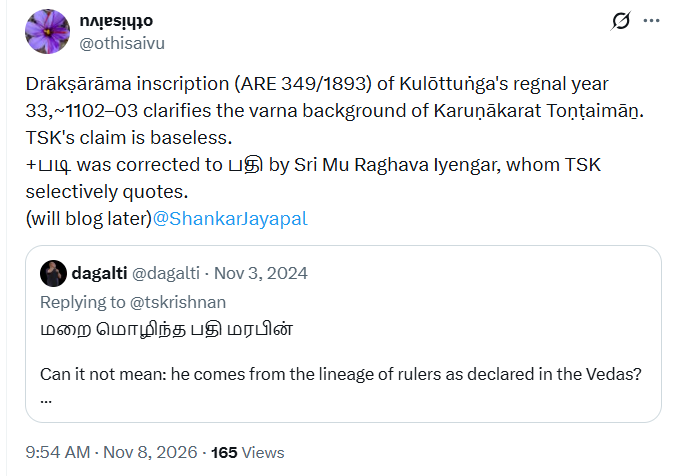
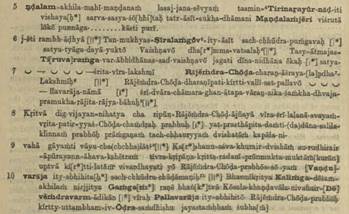
The strongest evidence for this is the Drākṣārāma inscription. It describes the commander identified by K. V. Subrahmanya Aiyer as Karunakara, and that commander’s father, as Śūdras. The inscription gives the commander the personal name Tiruvaraṅga and the titles [Vaṇḍu]varāja and Pallavarāja. The conclusion rests on the well-supported identification of that commander with the Karuṇākara named in the Kāñcīpuram inscription and celebrated by Jayamkondar/Jayaṅkoṇṭār.[1]
The circulating claim (not only of TSK) starts from a genuine historical fact. Karuṇākara led Kulōttuṅga I’s Kaliṅga expedition. It then turns Jayamkondar’s praise of his lineage into a statement that he came from a family of Veda reciters and was born a Brahmin. Two photographed palm leaves and the early editions examined read படி. The alternative பதி first appears in the evidence examined as Mu. Raghava Iyengar’s conjectural correction. His interpretation invokes Brahmā as an ancestor in a Pallava pedigree. That’s all.
It is to be noted that neither reading says that Karuṇākara was born a Brahmin.[2]
Scope of the rebuttal
The discussion seeks to examine TSK’s military and literary claims, the royal or Kṣatriya interpretation offered in reply to his assertions, and the subsequent ‘appeal to authority’ of TSK to Iyengar and Pallava genealogy.
It seeks to compare the actual wording of the poem/verse with what the sources say about the commander and his father. The figures reproduce source passages beside the analysis, so that there is no doubt. Copious and numbered footnotes identify the original editions, manuscript images and scholarly discussions – so that there is clarity about the sources quoted. Nothing is left to chance or ‘alternative’ interpretation or semantic fig-leaves.
Rest of the essay deals with the following sections:
The Kaliṅga expedition and the Rāma comparison
Grammar of the disputed lineage verse
Early printed editions and their variant notes
Palm leaf witnesses and remaining manuscript checks
Iyengar’s conjecture and the circulated extract
Later scholars and the Pallava pedigree
The Kāñcīpuram and Drākṣārāma inscriptions
The identification of the commander and the campaign chronology
Other military claims and the conclusion
4
The Kaliṅga Expedition and the Rāma Comparison
Jayamkondar, also called Jayaṅkoṇḍār/Jayaṅkoṇṭār, presents Karuṇākara as the lord of Vaṇḍai and an officer of Kulōttuṅga I, the king celebrated under the title Abhaya. Karuṇākara offers to strike the seven Kaliṅgas, receives permission, leads the army and directs it in battle.
The poem also presents him as Abhaya’s principal minister. Verses 341–342, 443, 460 and 471 support his command in this expedition. [3]
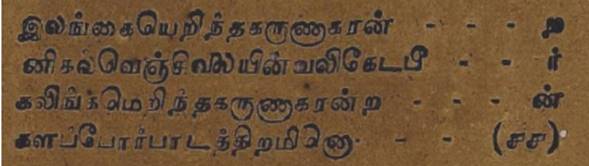
The Laṅkā stanza is II.44, numbered 64 in Project Madurai. It belongs to கடை திறப்பு, the section that calls on women to open their doors. The first Karuṇākara is Rāma, whose fierce bow struck Laṅkā. The second is the commander who struck Kaliṅga. The shared name allows Jayaṅkoṇṭār to set the two victories beside each other. வலிகேட்பீர் invokes hearing of the bow’s might and திறமினோ asks the addressees to open the doors so the battle can be sung.
Of course, TSK’s claim gets the comparison right and loses those two details – not that they are central to his other claim. True, the Laṅkā action in this stanza belongs to Rāma.[4]
Figure 1. Subbaraya’s Puduvai edition, II.44, printed p. 15. The older print has இகல்வெஞ்சிலையின், the reading quoted in the exchange.[5]
Gopala Aiyar quotes இகல்வெஞ் சிலையின் in his 1925 reply and defends his edition’s கடைதிறமின் on metrical grounds. Iyengar’s rejoinder and Subbu Reddiar give இசைவெஞ். Iyer takes the women as listeners. Iyengar reads an invitation to sing together. They also debate the stanza’s placement. Kanakasabhai Pillai explicitly identifies the Laṅkā figure with Rāma in 1890, and Mu. Arunachalam reaches the same reading.[6]
The account of warfare is exceptionally vivid. Its courtly paraṇi form includes epic comparisons, hyperbole (naturally!) and a supernatural feast on the battlefield. Those features support a claim about how the victory was commemorated. The description gives no comparative measure by which to rank the war among the fiercest in Tamil history.[7]
The published exchanges between Aiyar and Iyengar concern the Rāma stanza and other textual problems. They add no named witness for பதி at XI.30.[8] No, not at all.
5
Grammar of the Disputed Lineage Verse
The lineage passage is XI.30, in காளிக்குக் கூளி கூறியது. It is verse 328 in Gopala Aiyar and Iyengar and 341 in several later editions. The king has just ordered an attack. The chief/commander salutes him, promises to strike the seven Kaliṅgas and is described as the ruler of Vaṇḍai and the குலதிலகன், the ornament of his lineage.[9]
The reading படி
In மறை மொழிந்தபடி, the Veda speaks. படி makes the phrase mean “as the Veda declares” or “in accordance with what the Veda says.” The same poem uses மாமுனி மொழிந்த படியே at v. 185 for what the great sage said. With மரபின் வந்த, the disputed line presents Karuṇākara as the ornament of a lineage sanctioned or described in Vedic terms.
Palanivel Pillai glosses மறை as Veda and குலதிலகன் as a person eminent in his lineage.
Kausalya Hart renders the lineage praise in terms of the śāstras.[10]
Figure 2. Kanakasabhai Pillai’s 1890 translation of XI.30 interprets the lineage as royal and sanctioned by the Vedas.[11]
The proposed reading பதி
On Iyengar’s construction, மறை is what was uttered, மொழிந்த is the relative participle and பதி is the singular lord it qualifies. He identifies that lord with Brahmā. The clause then describes a lineage descending from the Veda-uttering lord.
Contrary to what TSK claims in the subsequent, rather flippant remarks – நீதிபதி and உமாபதி illustrate meanings of pati such as lord, master or husband. They cannot determine the reading of this line.
More importantly – the poem itself uses பதி for the ruler of North Kaliṅga at XI.27, which confirms that the sense “ruler” was available.[12]
The counterproposal that the Veda declared certain people to be rulers – resembles Kanakasabhai’s royal-lineage interpretation when read with படி. With பதி, it supplies an unexpressed predicate such as பதி என்று and an object such as the people so designated.
வண்டைநகர் அரசன் expressly gives Karuṇākara a ruling title. The verse gives no explicit Kṣatriya classification. (and, this goes against the doubt expressed by @dagalti)
The original claim about a family of Veda reciters is unsupported under either construction. The poem even has Kulōttuṅga learn the four Vedas from specialists at vv. 242–243, so Vedic learning alone would be an inadequate caste test.[13]
Jayamkondar’s பல்லவர் தோன்றல் at v. 534 associates Karuṇākara with the Pallavas and makes the allusion intelligible if one adopts Iyengar’s reconstruction. The poem also gives Kulōttuṅga a pedigree that runs through Viṣṇu and Brahmā at vv. 184–187.
Such royal genealogies express dynastic legitimacy. The sources give no documentary chain from the early Pallava kings to Karunakara’s immediate family.[14] (but TSK of course, has not considered all these requirements)
6
The Early Printed Evidence
The three early settings examined, print மறைமொழிந்தபடி. They seem to preserve evidence about the reading adopted by their editors. (to be clear – I, the author of the essay have not looked at any manuscript copies physically)
Figure 3. Subbaraya Mudaliyar, Puduvai, p. 79, XI.30. The verse reads மறைமொழிந்தபடி. The two digitized copies have the same typesetting at this verse.[15]
The Puduvai title page gives Śārvari, Aippasi, conventionally dated 1840, and says several copies were consulted. The errata correct XI.28 and XI.29 on p. 79 and give no correction to XI.30. Kanakasabhai’s 1890 article dates the first Madras printing to roughly twenty years earlier, a separate statement from the Puduvai imprint. Sastri says two people had already printed the poem. Gopala Aiyar says three preceded him. One reported pre-1898 printing remains unverified.[16]
Figure 4. Sastri’s 1898 edition, p. 70. The footnote under XI.30 concerns the following stanza, with துமிப்பனென் as a variant of துகைப்பனென்.[17]
Sastri’s preface reports nine copies and says variants were placed in footnotes. The 1923 editor consulted two Madras Government Manuscripts Library copies, seven or eight copies at Thanjavur and a Madurai Tamil Sangam leaf copy, and received readings from Kanakasundaram Pillai’s copy. In 1923 the printed notes begin at stanza 329. At 328 the digitized copy has a handwritten annotation apparently reading பிரமன் and an underline beneath படி. The unidentified and undated hand belongs to the copy’s later use. The printed edition supplies no variant there. Palanivel Pillai, Subbu Reddiar and the Project Madurai text retain படி.[18]
Figure 5. Gopala Aiyar, p. 48, stanza 328. Printed படி and the handwritten marginal gloss can be distinguished directly.[19]
7
Palm Leaf Witnesses and Remaining Manuscript Checks
Two photographs of the actual palm leaves establish that படி is a manuscript reading. Both manuscripts are held by the U. V. Swaminatha Iyer Library. The comparison below concerns the letter in this stanza. The dates and textual relationship of the two copies remain uncertain, though.[20] However, it is not a significant dampener on the argumentation.
Figure 6. MS 1415, image 038, blue label 37. The stanza starts on the right of line 5. In line 6, after the first string hole, the sequence contains ழிந்தபடி. The shape of டி differs from தி in குலதிலகன் farther along the same line.[21]
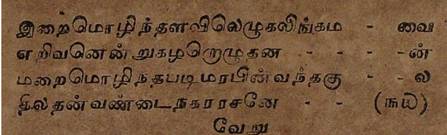
Figure 7. MS 1416, image 029, blue label 28. The stanza begins at the end of image 028 and continues here, with மறைமொழிந்தபடி near the middle of the top line.[22]
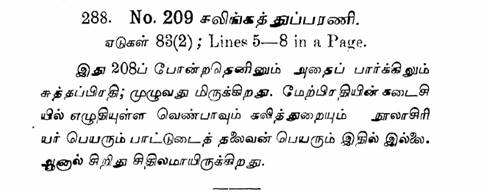
The Sarasvati Mahal catalogue lists seven copies, nos. 208–213 and 563, as entries 287–293. It says the copies vary among themselves and from the prints and confirms Gopala Aiyar’s use of the collection. The catalogue gives descriptions and sample lines without transcribing XI.30.
Searches in Gyan Bharatam, the National Mission catalogue and IGNCA’s Thanjavur microfilm index did not locate a public image for these witnesses.[23]
Figure 8. Sarasvati Mahal catalogue, p. 228. Entry 288 identifies MS 209 as complete and cleaner than MS 208.[24]
However, at the current level of rebuttal, I don’t think we need to scrounge around for more witnesses.
8
Iyengar’s Conjecture and the Circulated Extract
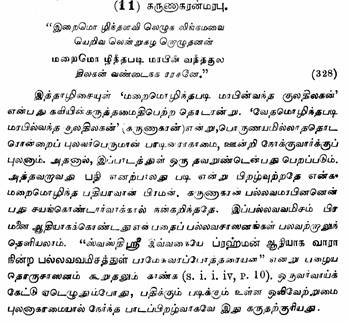
…In கருணாகரன்மரபு, §11 of his 1925 study, Mu. Raghava Iyengar quotes the poem with படி.
He regards the resulting lineage description as unsatisfactory, proposes பதி, identifies the lord as Brahmā and suggests that a scribe taking dictation confused the sounds. His positive citation is to a Pallava inscription. He names no manuscript reading பதி for this stanza.
In discussion of a different reading he identifies a Madras manuscript explicitly, illustrating the distinction between citing a witness and offering an emendation.[25]
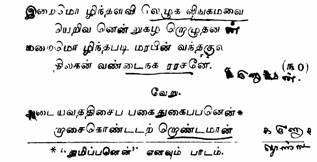
Figure 9. Iyengar’s original argument, Centamiḻ 23(5), p. 179. The quoted verse has the received படி. The prose below proposes பதி and gives the Brahmā interpretation.[26]
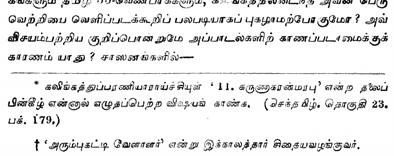
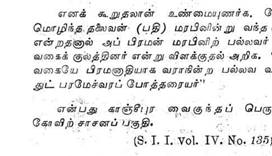
Figure 10. TSK circulated extract. Its typography and page break match pp. 440–441 of the 1984 facsimile of Iyengar’s 1938 collection.[27]
The passage also appeared in Centamiḻ 23(8), p. 302, where a footnote points directly to p. 179. In the collected version the corresponding note points to p. 420, the start of the renumbered §7. In context Iyengar is distinguishing Karuṇākara from Maṇavil Kāliṅgarāyaṉ, whose lineage he reads as Vēḷāḷar in separate inscriptions. The reply in the exchange accurately conveys Iyengar’s interpretation of பதி as Brahmā.
The snippet provided by TSK omits the reasoning by which he arrived at that spelling.[28]
Figure 11. The same argument in Centamiḻ, p. 302, with the footnote referring back to p. 179.[29]
9
Later Scholars and the Pallava Pedigree
N. C. Kandiah Pillai in 1938 and Rā. Raghava Iyengar in 1949 also quote பதி and identify the ancestor as Brahmā. Kandiah cites Mu Raghava Iyengar. elsewhere on the same page.
Of course – Rā. is a different scholar from Mu. and argues separately for a Brahmin origin for the early Pallava clan. K. A. Nilakanta Sastri also prefers the dental பதி and reads the verse as referring to descent from Brahmā. These works establish the reception of the reading.
Figure 12. Rā. Raghava Iyengar, commentary p. 13. He glosses the ancestor as the lord who uttered the Veda and cites the Vaikuṇṭha Perumāḷ inscription.[31]
The genealogy behind Iyengar’s interpretation is independently attested. The inscription at the Vaikuṇṭha Perumāḷ temple in Kāñcīpuram names Brahmā at the head of the Pallava race. The Kūram grant traces a line from Brahmā through Aṅgiras, Bṛhaspati, Bharadvāja, Droṇa and Aśvatthāman to Pallava. The Kāśākuḍi plates add Śaṃyu between Bṛhaspati and Bharadvāja. Their verse 18 combines Brahmin ancestry with Kṣatriya valour in its portrayal of the eponymous Pallava.
Emmanuel Francis treats this genealogy as a royal construction that explains a transition from sages to warriors and kings.[32]
Figure 13. South Indian Inscriptions IV, no. 135(A), the Kāñcīpuram temple inscription cited by Iyengar. Section A names Brahmā in the dynasty’s pedigree.[33]
Figure 14. Hultzsch’s translation of Kāśākuḍi v. 18. The formulation attributes Brahmin ancestry and Kṣatriya valour to the eponymous Pallava.[34]
10
The Kāñcīpuram and Drākṣārāma Inscriptions
Kāñcīpuram names Karunakara
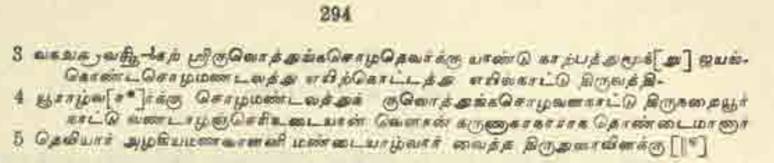
A lamp endowment in Kulōttuṅga I’s 43rd year, c. 1112–13, names Aḻakiyamaṇavāḷaṉi Maṇṭaiyāḻvār as the wife of வேளான் கருணாகரன், alias Toṇṭaimāṉ, of Vaṇḍāḻañcēri in Tirunaraiyūr-nāḍu.
The record is at the Aruḷāḷa Perumāḷ or Varadarāja temple in Kāñcīpuram. Aiyer took வேளான் as a clue to Śūdra status. The title can also denote a headman or official, so its evidentiary weight is lower than an explicit varṇa designation.[35]
Figure 15. SII IV, no. 862, p. 294, lines 3–5. The Tamil identifies Karuṇākara by his personal name and title and records his wife’s lamp endowment.[36]
Drākṣārāma names the father and son
The Sanskrit record dated to Kulōttuṅga I’s 33rd year, c. 1102–03, calls Śīrilaṅgō sac-chūdra-puṅgavaḥ, foremost among good Śūdras. It calls his son Tiruvaraṅga, styled [Vaṇḍu]varāja and Pallavarāja, sac-chūdra-cūḍāmaṇiḥ, the crest jewel among good Śūdras. Both Śūdra terms stand outside Aiyer’s restoration brackets and occur in the earlier Telugu-script edition. The text identifies father and son as Vaiṣṇavas and credits the son with victory in Kaliṅga and a pillar on the Oḍra frontier. The earlier publication is SII IV, no. 1239, ARE 349 of 1893. Aiyer re-edited the record in Epigraphia Indica XXII, no. 23, pp. 138–145.[37]
Figure 16. Epigraphia Indica XXII, p. 143. The two Śūdra epithets occur in lines 6 and 9–10 of Aiyer’s Sanskrit edition.[38]
The same record uses brāhmaṇa for ten beneficiaries of the grant. It thus distinguishes the social terms used of the beneficiaries from the epithets applied to the commander and his father.[39]
11
The Commander’s Identity and the Campaign Chronology
Aiyer identifies the two commanders through the cumulative match. The records place them in Tirunaraiyūr-nāḍu and give closely corresponding home names, Maṇḍalañjēri and Vaṇḍāḻañcēri. The Sanskrit titles correspond to the poem’s lord of Vaṇḍai and Pallava chief. Both accounts place the commander in Chola service and credit him with a Kaliṅga victory and a victory pillar. The distinct personal names and the partly restored [Vaṇḍu] title make the identification an inference.
Balasubrahmanyam, Rajaguru and Kuṭavāyil Bālacuppiramaṇiyaṉ also accept the identification. It is obvious that the explicit term Śūdra carries more weight about the commander’s family than a pedigree inferred from a disputed reading.[40]
Now. It is agreed that the identity of the commander and the identity of the expedition require separate judgments – so that there are no gaps in logic or loopholes and escape hatches.
Aiyer equated the expedition in the c. 1103 record with the poem’s campaign and dated it to c. 1076–77. He identified its Devendravarman with Rājarāja I. Nilakanta Sastri accepts the identification of the man and expressly rejects the equation of the campaigns. Sastri and Balasubrahmanyam place the poem’s campaign around 1110, against Anantavarman Chodaganga. On that dating, the c. 1103 inscription records a different campaign.[41]
Figure 17. Gopala Aiyar, p. 53, v. 362, corresponding to XI.64 and Project Madurai v. 375. The reading அனந்த பன்மன் names the king.[42]
The king’s name is itself a textual variant. Aiyer reports that Subbaraya and Suryanarayana Sastri read words corresponding to adipaṉ vīram at this point, where Gopala Aiyer prints அனந்த பன்மன். His gloss connects it to the inscriptional Anantavarman Chodaganga. In an endorsement appended to the 1923 edition, S. Krishnaswami Aiyangar calls the naming of Anantavarman a new feature and notes the wider manuscript base. Kanakasabhai’s 1890) gloss says only the ‘King of North Kaliṅga.’ Though this dating debate is somewhat inconclusive (to the extent that I could figure out), it leaves the varna terms in the inscription unaffected.[43]
12
Other Military Claims and the Conclusion
The poem securely celebrates Karunakara’s command in Kaliṅga. The Drākṣārāma record gives broader conquest praise. Oṭṭakkūttar’s Vikrama Cholan Ula, couplets 68–69, credits a Toṇṭaimāṉ celebrated in a paraṇi with victories against several rulers. Vengadaramaiah discusses those passages as evidence of further service. The Ula couplets give no personal name, dates or count of campaigns. Iyengar’s distinction between Karuṇākara and Maṇavil Kāliṅgarāyaṉ matters here, because crediting Karuṇākara with the latter’s separately attested exploits would inflate his record.[44]
But, it also important to note that the general claim that Brahmins could command Chola armies – is sound and attested.
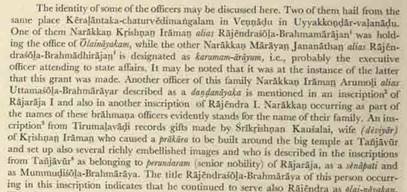
The edition of the Karandai Tamil Sangam plates discusses a Brahmana family and identifies Krishnan Raman, titled Mummuḍi-Chola-Brahmamārāyaṉ, as a sēnāpati. The comparison shows what affirmative documentation of Brahmin background can look like. The specific evidence for Karuṇākara points in the other direction.[45]
Figure 18. K. G. Krishnan’s edition of the Karandai Tamil Sangam plates, p. 28. The discussion connects the named commander Krishnan Raman with the documented Brahmana family.[46]
Conclusion
The conclusion is that Karuṇākara Toṇṭaimāṉ was not of Brahmin extraction.
This judgment rests on the identification, accepted by multiple scholars, of Karuṇākara with the Pallavarāja of Drākṣārāma. The record explicitly classifies that commander and his father as Śūdras.
The Kāñcīpuram title வேளான் supplies a separate, less decisive clue. The evidence supports a varṇa designation for the family on that identification. Of course, it does not establish a narrower jāti.[47]
The claim of Brahmin birth would still lack support if the identification were set aside.
The early prints and the two inspected leaves attest படி. Iyengar’s proposed பதி is a possible dynastic allusion to Brahmā, and the Pallava inscriptions explain why it appealed to him. Neither the Vedic formula nor the dynastic pedigree demonstrates that Karunakara’s immediate family was Brahmin.
The uncalled-for allegation by TSK that history is being twisted [in this context of Karuṇākara Toṇṭaimāṉ] adds no evidence to the claim.[48]
** (okay, I tool 2 hours for the prep work & 9+ hours for assembling this write up *phew* – and what do you think, mY fellow 7½s? Is it worth ‘publishing’ in this format with so much effort at all etc, eh?)
This longform post is about languages, roots, transmission directions in the context of Sanskrit & Tamil…
… and more importantly, it seeks to deal with suspect methodologies, premature optimizations, simplistic/superficial generalizations, giant logical leaps, self-referential statements, circular-reasoning, non-existing citations and the like, around some ideas – that have been plaguing the Tamil ‘discourse’ – or what passes for it.
I would also like to ascribe such seemingly unscholarly & infructuous approaches to a child-like eagerness/enthusiasm of some fundamentally good people – to ‘prove’ the ancientestest nature & origins of Tamil, in spite of all the evidence that stare at us in our face and associated kanging – and not to some deleterious motive. Okay – I agree that NOT all such folks are decent & ethical – leave alone being scholarly.
Normally, I do not indulge in major or sustained battles/discussions on X, because in my opinion, the context for the X-platform is not really about longform idea exchanges and also because I am not blue-ticked yet which would have otherwise allowed me to respond in longform. Also – ars longa vita brevis.
Again, I wanted to put in some significant time-effort in terms of approaching & analyzing this particular claim – as there are many many such types of uncalled-for claims that seem to be proliferating in the Tamil<->Sanskrit relationships – and I want to create some kind of a ‘template approach’ to deal with them. An exemplar, if you will.
Yes. I want to approach the claim as rigorously & as politely as possible, with a clear logic and marshalling of whatever evidence that I could muster; but of course I am not at all a Mr KnowAll and I do not have any scholarly pretensions. I continue to be an eager student of Tamil, Sanskrit & English – and assorted other things.
In any case, linguistics++ is only one of my minor interests, really. So, feel free to rebut/join etc in this discussion. Let us all learn together, if we can – with as much civility as needed and possible.
1
Background:
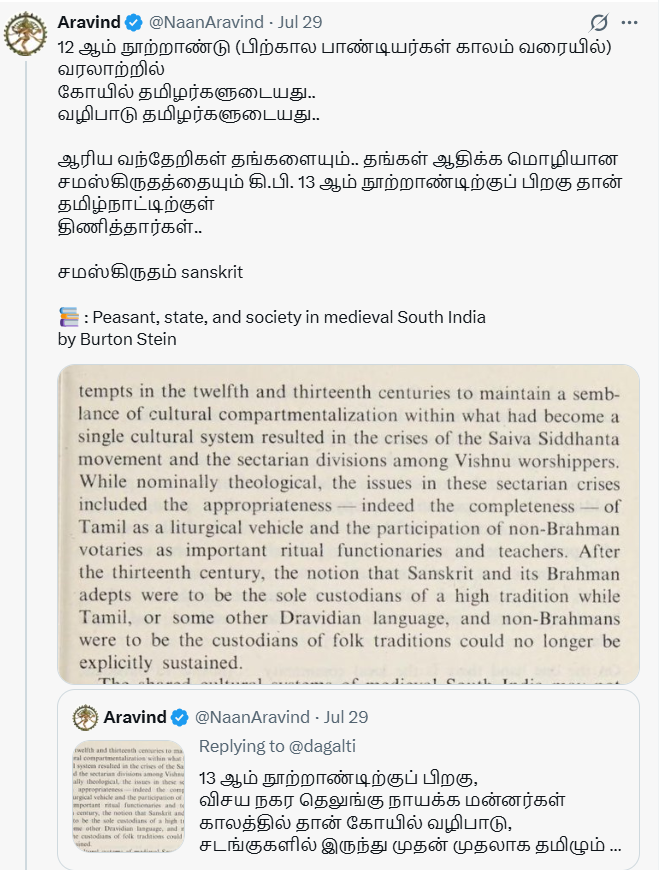
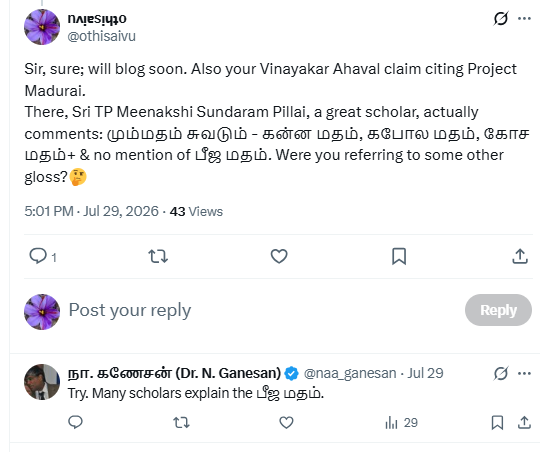
On July 29, 2026 this following discussion happened and I was not privy to that – am providing just the immediate context.
It was one rabid, frothing-at-the-mouth ‘Aravind’ who started off with an obtuse set of TamilSupremacist-Dravidian assertions. Pure unadulterated hatecraft. Usual story/fiction: Aryan invaders foisted themselves and Sanskrit on Tamilnadu post 13th century CE.
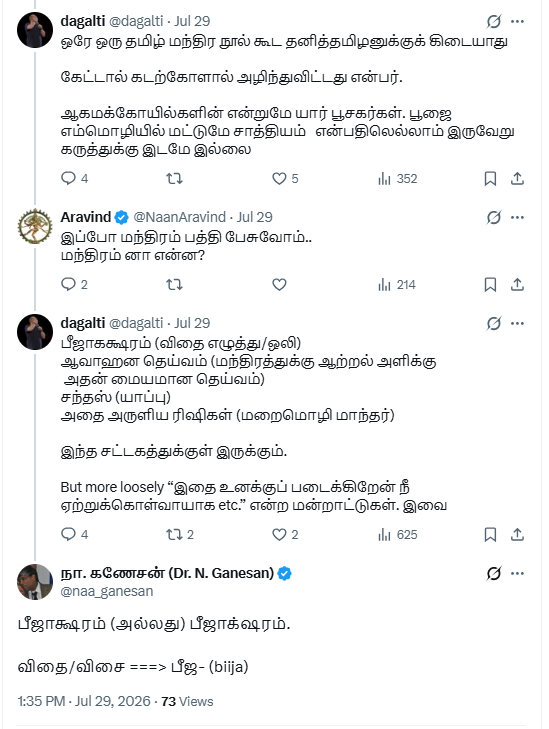
Here’s were Sri N Ganesan (henceforth NG) introduces the idea as in the subject/title of this post.
I responded to him – and this post is the result of that undertaking from me to respond soon.
There was also another short exchange between me and NG:
Rest of the post is going to be about expanding on my observation:
~”Sanskrit bīja ‘seed’ derives from Dravidian vittu/viccu/vīca” is NOT established by DEDR 5401 & is phonologically weak as presented.
Ideally I would like to use ‘Dravidian’ instead of Dravidian, since it is a made up category-name chistened fairly recently, unlike the monikers Tamil or Sanskrit. It also has this heavy baggage of having been politically loaded. But, writing ‘Dravidian’ everytime could be jarring, so am avoiding that.
To the extent that my typing would allow for, I have used International Phonetic Alphabet (IPA), showing the correct pronunciation..
2
DEDR 5401
Dravidian Etymological Dictionary of 1984 (often abbreviated as DEDR), is a major academic resource painstakingly compiled and annotated by T. Burrow and M. B. Emeneau. Very reasonably comprehensive.
DEDR 5401 refers to a particular entry – that groups a large set of Dravidian forms meaning ‘sow’, ‘seed’, ‘semen’, ‘testicle’, and related notions. The distribution across South, Central and North Dravidian languages makes the underlying Dravidian family cohesive.
It is important to remember as a backgrounder that, DEDR is a comparative dictionary organised into proposed etymological groups, rather than a series of claims that every listed surface form must be inherited directly and regularly.
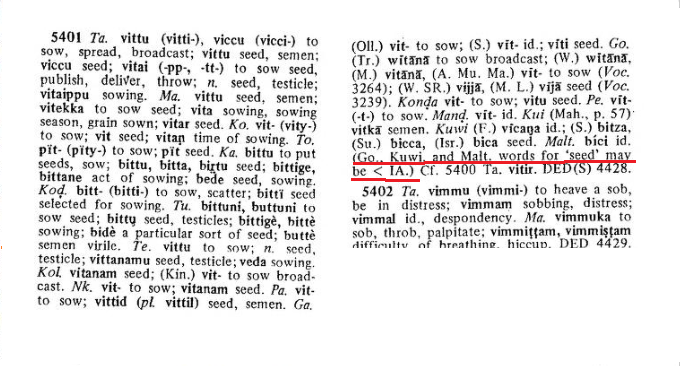
The important qualification occurs in the entry itself:
“Go., Kuwi, and Malt. words for ‘seed’ may be < IA.”
That warning matters. Burrow and Emeneau were explicitly allowing that forms such as Gondi vījā, Kuwi bica/bicca, and Malto bíci might be loans from Indo-Aryan, presumably from forms related to Sanskrit bīja.
Therefore, these particular forms cannot safely be used as independent evidence for a Dravidian development.
vittu -> viccu -> vīca -> bīja
That would risk circular reasoning. Some of the closest-sounding forms may already be Indo-Aryan loans.
3
What can reasonably be reconstructed for Dravidian?
The underlying family is usually represented approximately as something like:
verbal base *vit- / *vitt-, ‘to sow, scatter seed’
noun *vitt-, ‘seed’
derivatives with suffixes, such as Tamil vitai
The exact Proto-Dravidian reconstruction depends on how alternations among vit-, vitt-, vitay-, vicc- are analysed.
Tamil forms such as:
வித்து vittu, seed, semen
விதை vitai, seed
விதை- vita(i)-, to sow
விச்சு viccu, seed or sowing-related form
…belong to the same general Dravidian lexical family according to DEDR. That much is reasonable.
But DEDR 5401 does not itself reconstruct Sanskrit bīja from this family.
So, the reason as to why this extract was used by NG is not at all clear!
4
Is vittu > viccu plausible?
Tamil and its sister/other languages exhibit historically conditioned palatalisation and alternations involving k/c, c/y, and consonants adjacent to front vowels or y. However, a specific development vittu > viccu requires its own comparative and morphological evidence and should not be justified by a general Tamil rule tt > cc.
One cannot simply posit a general rule:tt > cc, without specifying:
the earlier phonological environment
the chronological stage
parallel examples
whether the form is inherited, dialectal, analogical or expressive
The examples given in the claim of NG do NOT establish such a rule.
பச்சை : பாசி – paccai and pāci cannot simply be treated as an illustration of free cc : c alternation. Their vowel quantities, morphology and lexical histories also need explanation.
கொவ்வை : கோவை – This pair likewise involves more than geminate simplification. It has differences in vowel length and medial consonantal structure.
Similarity alone does not prove that it illustrates the development required for vittu > viccu.
விச்சு : வீசு – This comparison is particularly problematic.
Tamil வீசு vīcu, ‘to throw, fling, wave, blow, spread’, belongs in DEDR to a separate comparison associated with scattering or throwing, referenced by DEDR 5400 vitir- in the quoted entry. DEDR’s “Cf. 5400 Ta. vitir” indicates comparison, not an assertion that vīcu regularly derives from vittu.
A derivation such as vittu > viccu > vīcu would require, at minimum:
tt > cc
loss of gemination cc > c
i > ī
and a semantic development
It may possible that each step might conceivably occur somewhere, but the sequence needs evidence.
It cannot be inferred merely from resemblance as comfortingly assumed & indicated by NG.
In fact, this ‘resemblance’ issue is the one that is there in most of the takes of ‘folk etymologists’ like Mannarmannan & Paari Saalan, that plague the Tamil discussions.
5
The proposed vīca > bīja equation
This is the weakest part of the argument or the process for claim by NG.
Sanskrit bīja /biːd͡ʑa/ ‘seed’ and a proposed Dravidian form vīca or vīja look moderately similar, but historical etymology requires regular sound correspondences.
A borrowing from Dravidian *vitt- into Indo-Aryan as bīja (as claimed by NG) would definitely require explanations for:
Dravidian
Sanskrit
Problem
initial v-
b-
Possible in some borrowing situations, but must be demonstrated
medial -tt-
-j-
No obvious regular substitution
final consonant
final -a
Sanskrit nominal adaptation is possible
short i
long ī
Requires an account or an example
geminate stop
voiced palatal affricate
Major unexplained change, this is surprising
The change *vitt- > bīja- is therefore not a transparent or recognised sound substitution – UNLESS NG can satisfy every one of the above 5 criteria.
One might instead compare the later Dravidian forms vīja, bica, bíci, but DEDR itself warns that precisely these may come from Indo-Aryan.
They are consequently poor evidence for the opposite direction (Dravidian -> Sanskrit) of borrowing.
6
What is the accepted etymology of Sanskrit bīja?
Sanskrit bīja unquestionably means ‘seed’, and by extension ‘germ’, ‘source’, ‘cause’, generative material, semen and, in tantric usage, a ‘seed syllable’. The semantic explanation of bīja-mantra as a compact sound containing generative spiritual potency is traditional and unobjectionable.
I will NOT dispute that its deeper etymology, however, is uncertain at least in my limited knowledge. It seems to lack a straightforward and universally accepted Indo-European derivation. Such uncertainty makes a substrate or borrowing hypothesis possible in principle, but:
‘Uncertain within Indo-European’ does not automatically mean ‘borrowed from Dravidian!’
To establish Dravidian origin, scholars like NG would definitely need:
a reconstructible Dravidian source form predating Indo-Aryan attestation
regular or independently paralleled sound substitutions
plausible geographical and chronological contact
and exclusion of borrowing in the reverse direction
The proposed argument of NG supplies mainly semantic similarity and surface resemblance.
But one needs arguments that are really sound and substantive to present a scholarly take!
7
Is vit- a Sanskrit dhātu derived from Dravidian?
The wording of NG: “vit- is the dhātu-vēr in Dravidian” unfortunately mixes Sanskrit grammatical terminology with comparative reconstruction.
A better formulation would perhaps be: “Proto-Dravidian appears to have had a verbal root or base *vit- / *vitt-, ‘sow’.”
Calling it a dhātu is understandable informally, but Sanskrit grammatical roots and comparative Dravidian reconstructions belong to different descriptive frameworks.
Further, the existence of a (A) Dravidian root *vit- does not show that (B) Sanskrit bīja comes from it.
The two propositions A and B are separate which NG has to note of.
8
The Vināyakar Akaval claim
The contentious line is: “மூன்று கண்ணும் மும்மதச் சுவடும்..”
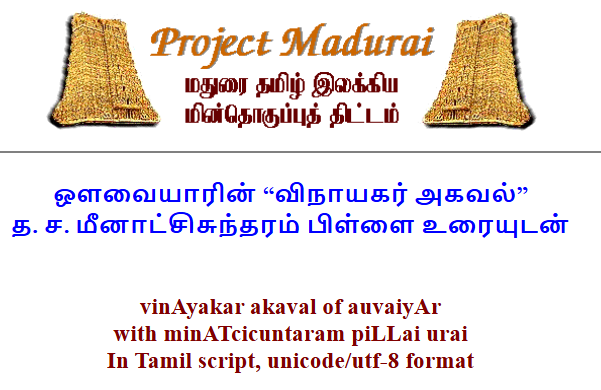
Project Madurai’s text (specifically cited by NG) and commentary interpret மும்மதச் சுவடு as the marks or traces produced by three kinds or streams of elephant rut-fluid. The particular commentary of the great Sri TP Meenakshi Sundaram Pillai, hosted there gives the names of those 3 as: கன்ன மதம், கபோல மதம், கோச மதம்…
…one would suppose that, after referring to the Project Madurai in the context of Akaval, NG would quote this exact reference, actually cited by him!
But NG ‘quotes’ something different! கர்ண மதம், கபோல மதம், பீஜ மதம்!! பீஜ and NOT கோச as in his reference! When asked about NG replied, as in the snippet from the Section1 above – “many scholars explain the பீஜ மதம்.”
I was slightly surprised by the defensive ‘I am my own citation’ kind of response, but that’s not a significant issue in the big picture of a host of other concerning lacunae in the claims of NG.
Of course one is aware that in a few glosses of the phrase mummdam, bīja-mada is given as a lexical explanation – but then NONE of them are of the incredible scholarly levels of Sri TPM Pillai!
Therefore:
மும்மதம் in the poem has no etymological bearing on Sanskrit bīja.
The reading பீஜ மதம் appears to be one modern anatomical or Sanskritising gloss among variants.
Even were bīja-mada an authentic technical term, it would merely use Sanskrit bīja in the sense ‘semen/generative fluid’. It would not prove that bīja originated in Tamil or Dravidian.
The poem ‘Vinayakar Akaval’ brought in by NG to prove his claim, is consequently irrelevant to the proposed etymology.
9
Conclusion
I hope, at least Dr N Ganesan has read this far… :-) In spite of this post is already some 1900+ words in length! Loooooong form indeed! But I think it would be an useful template or a framework to respond to such claims, hopefully… at least for me!
It also took me upwards of 7 hours to process claims, collect details, organize them and then respond comprehensively (one hopes so!) to the claims made by NG.
But.
I would be very eager to know NG’s response (and interested others) in terms of defending or revising his claims – point-by-point AND with tangible, verifiable & scholarly evidence.
Anyway. Here’s hoping this would encourage decent & evidence-logic based discussions on one of the vexatious issues with our Tamil. Thanks.
“The horror! The horror!“ — Joseph Conrad (in his 1899 novella ‘Heart of Darkness’)
(THIS, even before KYC and OTP were nowhere on the event horizon? Are you for real, you bloody wimpy JConrad?)
(skip to section 1, if you only want to read a real life horror story – if not, you can start reading right from here; of course, I would never ask for your personal details or OTPs so beware of scamsters! Don’t click on suspicious links!!)*
1
The normal ‘we all happily died ever after’ kind of innocent fairytale narratives about the OTP (One Time Password – that, one receives on a mobilephone as SMS/WhatsApp msg or on email for pre-verification, leading to some transaction) and the process of KYC (Know Your Customer, supposedly) are that – any given service enterprise ought to do periodically – pre birth, life, quick-death AND after-death of the ‘Customer.’
Of course, all very understandable in the current contexts of frauds, need to establish a clear identification of a person & the necessity to maintain trails to establish accountability & traceability in processes.
But.
OTPs have taken over every aspect of life in the given shortened-life of the average citizens – and not only that, they attack in a pack with ravenous KYC processes.
Oh, the horror, the horror…
2
Dunno when I fell asleep. Actually I don’t even know whether I even slept, given my continuing OTP-KYC nightmares. May be I am still caught in the same web of mortal terror.
It doesn’t matter. I think I am awake now, so I am.
…I think, it all started when I suddenly realized that I had become a senior citizen and that I was going to be taken over by the hordes of 3letter abbreviations. No. It wasn’t G.O.D. Silly. Realize that It/He/She GOD may not be omnipotent, omnipresent and omniscient – but OTPs and KYCs certainly are.
…But, even then, I didn’t know what was to come and hit me hard, real hard… In fact, I knew naught, how the damn OTP ensured total KYC – Kill Your Customer. The details of the hit of course included recursively handing over multiple copies of Aadhaar Identification and Income tax PAN cards (of both sides) of course, which had to be self-certified, signed in black ink etc… (the only saving grace is that, one does not need to get notarized notorious public lawyers’ authenticating signature and stuff)
Fact & single sentence story is that, I merely went to a Bank, and then all hell broke loose and I was quickly caught-up in a massively tangled web of OTPs and KYC processes… As the natural and logical following step, I fainted…
3
By the year 2032, India had finally achieved what emperors, invading islamic hordes, marauding christian padres, economystics, socialists, congressis, left-liberals, homeland visiting NRIs & dravidian scum never could:
total citizen obedience through OTP verification!
Nothing moved without a One-Time Password & KYC.
Weddings. Funerals. You name it..
Not even bowel movements in AI enabled premium smart toilets.
Sixty-eight-year-old Mr. Ramasami Othisaivu discovered this on a humid Tuesday morning when he tried to die peacefully at his home in the outskirts of Bengaluru.
The heart attack itself proceeded rather smoothly.
But the ambulance did not. Oh what to do…
“Sir,” said the paramedic, kneeling beside the semi-unconscious man, “before we begin CPR, please confirm the OTP sent to your registered mobile number ending in 7407.”
Ramasami, being temporarily & incrementally dead, did not respond.
The paramedic sighed. “Happens every day.”
His wife, Lalitha, grabbed the phone. “Ayyo! It’s asking for biometric confirmation also!”
“Madam, government regulations! Too many fraudulent resuscitations.”
But the OTP got delayed, because the SMS gateway was crawling to a halt thanks to millions of citizens simultaneously verifying attendance for National Productivity Yoga Hour & billions booking FirstDayFirstShow tickets all over the world for the Vijay blockbuster ‘DigVijay, The Permanent Emperor of India.’
Incidentally, this film release was the only promise made in the manifesto of his political party “Thamizhaga Vetri Kazhagam’ (Tamilnadu Victory Party) that successfully formed the Union Government in India post the 2029 Loksabha elections, after a massive sweep of 540 out of ~544 seats!
…
…however, the WhatsApp OTP came faster, but only after watching a 50-second ad for just-in-time Life Insurance for soon-to-be-dead Customers, of course subject to KYC – followed by a 30 second promo for DigVijay, with some recommendations of Instagram reels of Vijay fans.
…In the meantime, Ramasami briefly regained consciousness just long enough to whisper, “Check spam folder… in gmail, just in case…”
Then flatlined again.
An offer from Amazon (co-sponsored by Project Vaikuntha) landed in Laitha’s mobile – about, a cool & attractive ‘premium branded ashes immersion package’ in Kashi, at 90% final rebate + GST.
Another cheerful duplicate OTP made it to Ramasami’s WhatsApp, saying “In case you are already dead, kindly ignore this OTP. In case you didn’t receive this message, send an YES to +91 19119 11911 via SMS.”
4
At the hospital reception, the young lady with a plastic smile, responded professionally, in an accent halfway between India and USA. Probably an AI enabled hologram.
“Say 1 for English, 2 for Hindi, 3 for Kannada, 4 for Braille, 6 for Signlanguage, 7 for ASCII, 8 for Morse code, 9 for back to previous menu…”
“1”
“Thanks for choosing 1. Say 1 for American English, 2 for British English, 3 for Indian English…”
“3”
“Thanks for choosing 3. Say 1 for Hinglish, 2 for Kinglish, 3 for Tanglish, 4 for Telgish, 5 for Mallish…”
“3”
“Check your OTP”
… …
“Welcome to Kailash Direct Hospitals. How can I serve you?”
“QUICKLY?!”
“Ok Madam… Death or semi-death package, madam?”
“Death.”
“Due to what?”
“Due to OTPs and KYC. And delays…”
“Okay, we are sorry to hear that,” the young lady smiles, while checking her WhatsApp for VIjay film release updates, “but was it Basic death or Aadhaar-linked death?”
“What’s the difference?”
“In Aadhaar-linked death, your husband receives loyalty points redeemable in the afterlife ecosystem.”
Lalitha stared.
“Fine,” said the clerk. “I’ll select maybe.”
A new OTP got generated and sent.
But, unfortunately, the OTP was sent to Ramasami’s old SIM card, which had been deactivated because he had failed re-KYC for insufficient blinking during facial verification.
“Can we use my number?” asked Lalitha desperately.
“No, madam. Relationship transfer requires Form 18-C, notarized by two blood relatives and one chartered accountant. And, we will have to do fresh KYC for all of them, including the Notary Public lawyer.”
5
At the crematorium, things got better.
The electric cremation chamber displayed:
USER NOT VERIFIED PLEASE COMPLETE MANDATORY KYC BEFORE POWER-ON
A weary employee approached carrying a ring light and fingerprint scanner.
“Yes madam – it is the usual KYC process here, Know Your Corpse.”
They pressed Ramasami’s thumb onto the scanner.
FINGER NOT ALIVE ENOUGH
“Try other hand, or some other finger…,” suggested the employee.
6
Meanwhile, the family WhatsApp group exploded.
“UNCLE DEAD??? SOURCE??”
“Too much fake news these days.”
“Please share OTP for condolences.”
“Om shanti RIP!”
“In ‘States’ nobody asks for Aadhaar!”
“Fake news! Uncle was heartless! How can HE have a heart attack!!??”
“gr8 news brb”
…
A cousin in Dubai launched a Google Meet prayer session, but nobody could join because the authentication SMS was delayed.
This was because Dubai data centers & telecommunication providers hosting SMS gateways were hit by missiles from Iran.
7
Then came the final obstacle: ‘Ashes Release Authorization.”
The municipal officer adjusted his spectacles.
“Madam, before collecting ashes, kindly verify whether the deceased wishes to remain carbon-neutral.”
“How would he know?”
“AI prediction available for Rs. 299/- plus GST.”
Lalitha finally snapped.
“For FIFTY years this man paid taxes, linked Aadhaar, linked PAN, linked LPG, linked bank accounts, linked voter ID, linked water pipeline, linked insurance, linked Spotify family plan, linked Netflix subscription — and now even his soul is buffering??! What the hell!!”
The officer nodded sympathetically.
“Happened to my father also. His reincarnation got delayed because OTP server was down.”
At sunset, Ramasami was finally cremated after successful e-KYC, OTP verification, liveness non-detection, and acceptance of updated Terms & Conditions.
…
Far above, at the entrance to heaven, a celestial receptionist looked up.
“Welcome, Mr. Othisaivu. Are you part of DIE quota?”
“Am not sure madam. I am already dead!”
“Nonno sir, we want to know whether you are protected by Diversity-Inclusion-Equity laws?”
“Well, I am from OTP positive community, not sure whether…”
“Okay, okay – I get it. You are cattle-class – now, before entry, please verify the OTP sent to your registered WhatsApp.”
Ramasami closed his eyes in weariness.
“Send me to hell,” he said quietly. “At least there they pick up the phone & don’t play hold-music.”
“Sir, their AI call-center has a five-star rating, but they will still have to do a fresh KYC, link your hell admit card to Aadhaar and of course there would be OTPs and further physical residential address & conduct verifications by their Yama’s agents…”
“Send me back to earth, please!”
“Yes, but first take our Customer Satisfaction Survey. Be sure to give me a five-star rating because my performance appraisal is due next week!”
“Sure, am used to these surveys. where is the link?”
“Scan this QR code first and then you will get an OTP; a KYC check would be done by the way, and here is the form – and please note – this conversation is being recorded for Quality Improvement & Training purposes…”
8
Ramasami woke up in cold sweat and promptly had a real heart-attack.
This was a 12th grade Gestalt moment for me, of course ages ago: Even in ‘Chemical’ reactions, the mass-energy equivalence applies, like mass-defect in the Nuclear ones.
Chemical reaction energies (endothermic/exothermic) arise from electronic interactions++; the associated mass defect is a secondary consequence.
E=mc² For The Win. YES!
1
Many of us erroneously assume that Chemical energy creation (or absorption) does not involve anything like mass-energy equivalence; and that, ‘masses are like totally conserved in chemical reactions.’ That, the ‘sum of the masses of reactants on the left hand side of an equation, are equal to the products/results on the right hand side.’
Our school textbooks (hic) feed the ignorance by creating random differences between nuclear and chemical processes/reactions – which our otherwise mediocre ‘teachers’ follow like automatons; of course, there are obvious differences though.
(having been a school-teacher before – and sorta continuing as a low intensity one-on-one teacher/cheater for a while, and stressing on the idea ad infinitum – I can say with a huge satisfaction that many of my young learners have had such similar gestalt moments of wonder that is Science!)
2
FACT: Even the burning of firewood has to adhere to the stellar idea of Mass-Energy equivalence as fantastically propounded by Albert Einstein.
The basic interaction/reaction in ‘burning firewood resulting in smoke & heat/light’ is of carbon atoms combining with oxygen molecules to produce carbon dioxide:
C + O2 → CO2 + 4.08 eV.
Remember: 1 electron volt (eV) = ~1.6 × 10⁻¹⁹ joule (J) = ~3.83 x 10⁻²⁰ calorie. A calorie is nothing but the heat energy required to increase the temperature of 1 gram of water by 1 degree centigrade; of course 1 eV has a very, very small or insignificant heat equivalent – but, the fact is that it exists.
Anyway. In this exothermic (heat releasing) chemical reaction, 4.08 eV of energy is released for each reacting carbon atom; it is referred to as the binding energy (BE) of CO2 molecule.
Again, as a reverse reaction – if 4.08 eV of energy is given to a CO2 molecule under suitable conditions, it will break up into its constituents as in:
CO2 + 4.08 eV → C + O2
… what this means is 4.08 eV energy leaves the system to form CO2 gas. Therefore, the mass of CO2 molecule will be less than the total mass of C and O2 by a mass equivalent of 4.08 eV.
This loss of mass Δm can be calculated using the brilliant equivalence relation E = mc2 …
Of course, such a small change in mass cannot be detected and we say without batting an eyelid that the mass is conserved in chemical reactions, though slight change of mass does occur.
(In one gram of Carbon, there are ~5.02 × 10²² atoms; when one gram of Carbon is burnt thus, the heat released is 7800 calories)
3
Summarizing various aspects of chemical reactions…
Energies of the order of 10 eV are involved. (in Nuclear ones, the order is in MeV – million/mega eVs = 106 eVs)
Change of mass is of the order of 10–35 kg, which is extremely small and so we claim that the mass is conserved.
The total number of atoms of each type on the right hand side of a given chemical equation is always equal to the total number of atoms of each type on the left hand side.
Chemical energy comes from electronic structure changes (rearrangement of valence electrons, bond formation/breaking) – & is governed by electromagnetic interactions
The mass change is a derived consequence, not the driver
In a chemical bond – the electrons rearrange into a more stable (lower-energy) configuration
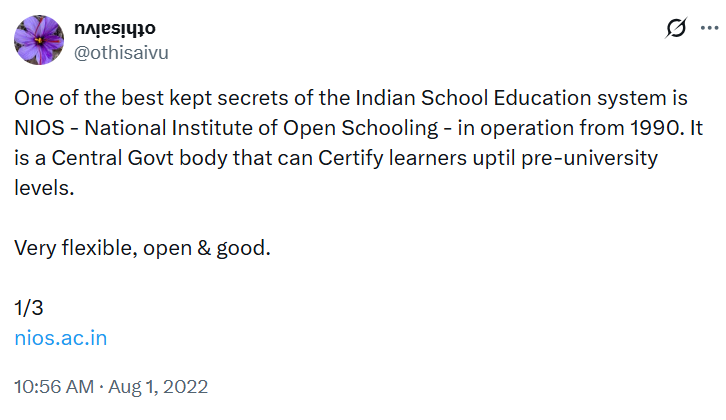
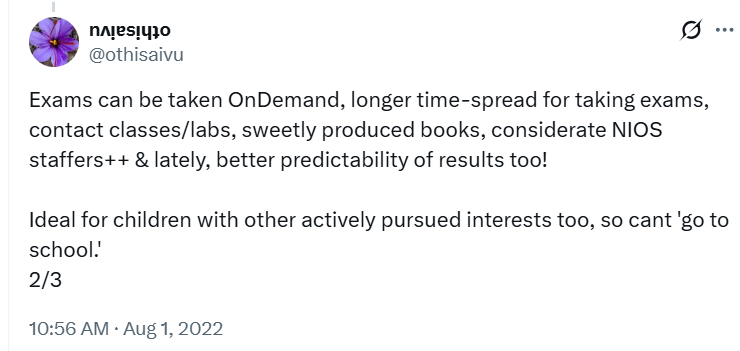
Only once in a while, I agree to work with some lad/lass or the other, in the specific context of exams/tests of some certification board or the other…
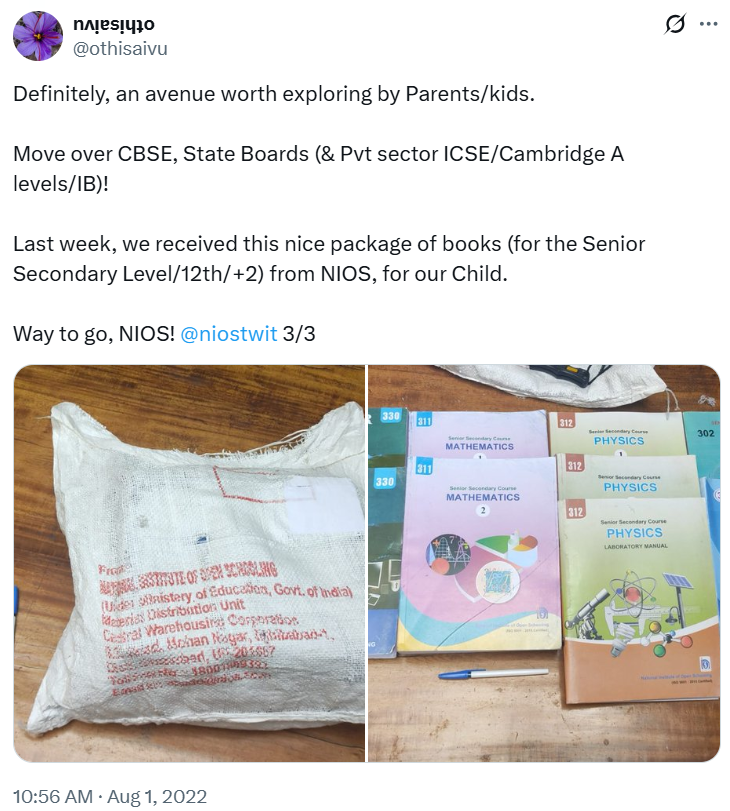
In such a context, I was recently working with a lad on Physics for his higher secondary (or +2) curriculum of NIOS board (National Institute of Open Schooling – a Central Government & a stellar entity – that I admire for n reasons) and shared with him, some notes on test taking in general and NIOS physics in parts/specific – and am sharing that stuff for whatever it is worth; of course, I also know from the earlier such iterations of the deal that, this sort of ‘handy & no-nonsense guide’ is useful to students and parents. So.
2
Okay, the following is the verbatim text of what I told (um, it was more like a discussion, though) the lad about the exams in general and as to how one ought to look at them. (a little bit of editing has happened, primarily to anonymize and the like)
NIOS exam-taking – why & howto: notes
See, am all for gathering knowledge, wisdom and all that – including the exhilaration that comes from really ‘knowing’ something – the aha! moment. I respect intelligence very highly, and admire high IQ folks, of course. But ALL these should not prevent one from scoring good marks in exams, especially when it is an useful, ethical idea – that goes alongside the [human] evolutionary imperatives.
More often than not, discipline & agency take one far, much far beyond one’s smartness/intelligence alone could.
Exams are important indicators of one’s stamina, ability to communicate clearly, accurately & with precision. They also provide some input as filtering criteria for competitive places, & in various aspects of life, later.
(Test/Exam results may get affected by the day’s weather, which should not be over or underrated – one should sufficiently scaffold/plan for the exams in terms of physical health, wellbeing & alertness; and, you must note that – but by and large the exams are useful for interpreting comparative performances & for arriving at quick/first-cut impressions – we informally do it ALL the time!)
True, there are folks who did not take exams and outshone many others in their later lives – but one NEVER hears of the vast majority of people, who did not take exams [seriously] for some quirky, semi-literate reason or the other – and then went on to lead less-than-mediocre lives.
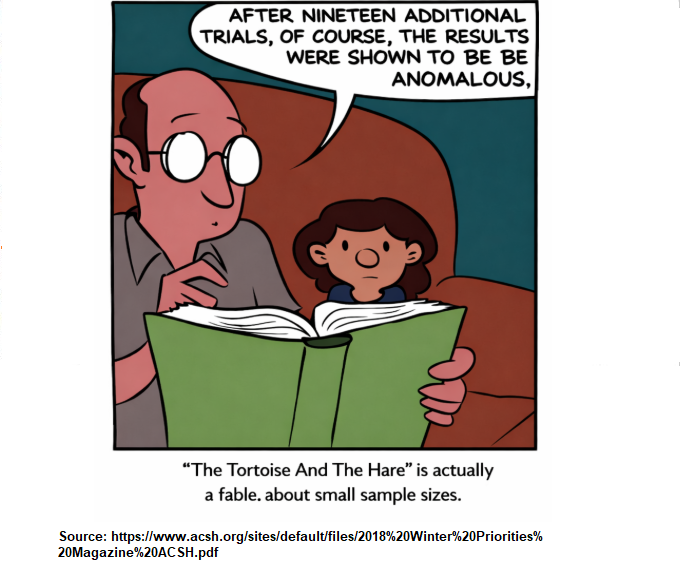
Don’t generalize based on small sample sizes, EVER.
Based on the ‘exam results’ and going to good schools, for any given student so far, has helped in the ways of networking, brand-recognition, associating-with-and-learning-from-peers, and may be even in virtue-signaling/preening deals. And, entry to most good schools is invariably through performance in one test or other other.
Not that I need to tell you – but it would help to remember that YOU chose to take the exams mode – no need to tell oneself that ‘I was forced to take the exam’ etc since that would be anti-selfrespect/agency.
Since you chose to take the exams, you should do a bloody damn-good job of them. “Anything that HAS to be done, MUST be done cheerfully” – certainly not by way of kicking and screaming and wailing and lamenting…
…
Anyway…
Understanding the NIOS Exam Reality: (this is generally true for any exam/test)
NIOS questions are directly tied to the NIOS textbook language – (but not so much as CBSE/ISC) – but it helps to communicate as per ‘marking scheme’ which is derived from the text.
Many questions are definition, derivation- and formula-driven, not necessarily novelty-based – therefore, most are straightforward. (‘Cambridge’ A levels make a laboured pretense or a fetish of it, CBSE does okay with novelty – ISC is, well, ISC is non-novelty pro-maxx, most Stateboard syllabi are excretal – so let us not go there)
Marking is generally steps-based, not just final-answer based.
Examiners/Evaluators look for recognizable keywords from the syllabus. (one should be kind to them, as they are doing a boring job otherwise! The sooner AI takes this over, the better it is for everyone)
Diagrams and formula statements often carry independent marks.
Neatness and structure matter more than elegance.
Sometimes Qs do appear from TMA (Tutor Mark Assignment – another way to say non-exam) chapters, not only from PE (Physical Exam) chapters – so, there is no harm in working-thru the TME chapters, and anyway they do enhance the levels of understanding of a given set of ideas.
Generally one is given marks for ‘knowing stuff’ and not penalized for ‘not knowing stuff.’ No negative marks, that is! Fair game. But any self-respecting guy would NOT attempt to bullshit one’s way thru.
…
Before the Exam: Preparation approaches/tactics:
NO need to have an anti-rote mentality – as I said umpteen times, rote-memorization is CRITICAL across subjects and behaviours. It reduces response times, processing overloads + increases confidence levels & productivity.
Study strictly from the official NIO Physics textbook first; and then, use ‘learning guides’ secondarily for RL (Reinforcement Learning), searing fundas in to the brain and do revisions. (you should prefer your own, handwritten notes)
Of course, nothing prevents you from immersing yourself in Feynmans of the world. The pitamahas.
Make a formula notebook chapter-wise; rewrite multiple times. Stick up posters with the formulae and ideas that you want to internalized. Keep staring at them. Eidetic memory can help, of course.
Memorize standard derivations exactly as in the book (sequence, a logical approach do matter).
Practice numericals from solved examples in the textbook—many are repeated with value changes. (Don’t simply & uselessly read the solved-examples – but read the Qs attempt a decent response and then check the latter with the solution approach given…
Learn units, symbols, and SI (International System) conventions exactly (marks are subtracted for unit errors, of course!).
Identify chapters that are: (…and allocate time accordingly)
high weightage (already done)
theory-heavy
numerical-heavy
Practice drawing circuit diagrams, ray diagrams, graphs by hand (quickly and cleanly).
Time yourself doing 3-hour full/mock papers at least FIVE times before the exam – review the answers, debug your approaches, so that, from mock to mock, there is a significant improvement
Learn definitions verbatim for, say – ideas/concepts like electric field, magnetic flux, emf, capacitance, wavelength, frequency, etc etc.
…
Exam-Day Mental Setup – these you should actively tell yourself, so that you do not forget etc:
Enter the exam expecting straightforward but unforgiving checking.
Do not attempt to “impress” the examiner/evaluator – clarity beats sophistication.
If nervous, plan to start with (lower valued ones) 2-mark questions to settle rhythm.
Never leave a question blank/unattempted – partial marks are common. (besides the blank ones make one look negative)
Take a bottle of water, keep it under the chair – so that you don’t accidentally topple it on the answerscript etc
Take some very-sweet chocolate, it melts in the mouth swiftly and supplies instant sugar to the starved/scared brain.
Wear warm clothes/jacket – you can always remove them, or use them as butt padding.
Don’t bother about how others are behaving – just focus on the deal
…
Reading the Question Paper:
Read the entire paper once before writing anything.
Underline (at least mentally) command words such as: define, derive, explain, state, calculate etc – and respond accordingly and to the point; no rambling.
Identify which questions are focused on, say theory vs numericals vs diagrams.
Check internal choices carefully; pick what you know best, not what looks shorter.
Note mark distribution and plan time: ~1.5 minutes per mark is a safe average. (80 marks – 180 minutes)
…
Writing Answers: General Rules:
Good handwriting helps (of course, I have a bad handwriting, mea culpa – so am saying this from experience; honestly, somewhat passable handwriting could have really helped me in various ways… leave alone the fact that, it would have been a considerate gesture on my part, towards that hapless evaluator of my answerscript – which in turn of course would have helped me etc)
Begin every answer on a new line; separate sub-parts clearly.
Write point-wise answers whenever possible.
Always write the formula first, even if calculation is trivial.
Box or underline the final numerical answer.
Write units explicitly at every step (V, A, T, J, m-1, etc.).
Maintain a left margin (or some such predictable space, but consistent through-out your answerscript) for rough work or corrections.
Striking out needs to be neat. (otherwise not only does it look awful, but also it is a waste of time – opportunity costs etc)
…
Physics-Specific answering approach:
For numericals:
Given:
To find:
Formula:
Substitution:
Final answer with unit
(a structure such as the above, itself could potentially earn marks)
Even if the final number is wrong, correct method gets marks.
Draw labeled diagrams wherever remotely relevant – they also help you focus on relevant things.
For derivations:
Start with physical situation
Write assumptions
Proceed stepwise
End with final result clearly boxed
For laws/principles:
Statement
Mathematical form
Explanation of symbols
Units (if applicable)
…
Handling Diagrams and Graphs:
Use a pencil and ruler for diagrams.
Label everything – including axes in graphs with:
Idea/concept
Quantity
Symbol
Unit
Mark important points (origin, intercepts, maxima).
Even rough but correctly labeled diagrams score marks.
…
Managing Time during the Exam:
Do not spend more than:
4 – 5 minutes on a 2-mark question
10 – 12 minutes on a 5-mark question
If stuck, leave space and move on. (remember to get back to this when you are done with the rest)
Reserve 10 – 15 minutes at the end for revision.
Use the last minutes to:
check units
check sign errors
complete unfinished derivations/numericals
…
Common Mistakes to Avoid:
Writing long paragraphs when a definition was asked.
Skipping steps in derivations.
Writing answers without units.
Mixing-up CGS and SI units.
Using/expanding prefixes – milli micro kilo etc – and forgetting to use their numerical value.
Overwriting or cutting excessively.
Using symbols inconsistently within the Q scope (e.g., using V for velocity).
Assuming the examiner/evaluator will ‘understand what you mean’ etc
Ignoring internal choices without reading both options.
…
You ought to be Smart, so:
Attempt all questions, even weak ones.
For theory questions, you partially know:
write the correct definition
add a diagram
state one application
(the above would often cross a passable threshold)
Reproduce textbook phrasing when unsure.
If short of time, prioritize completing all questions over perfecting few.
…
Final ‘Psych’ related pointers:
NIOS exams reward discipline, not necessarily brilliance – same is the case with CBSE. (not that this is bad; the fact is that there are no pretensions as in A levels (of Cambridge types) or the plain jack-assed nature of ISC types; the less is said about the stateboards, the better it is!)
Accuracy beats creativity.
Calm writing scores more than rushed brilliance.
The examiner wants reasons to give marks – therefore make the reasons visible obvious.
Have pity on the poor evaluator-examiner – help him along to evaluate you, don’t tire him out or make him/her exasperated with your response; nonsense is eminently avoidable, ALWAYS…
Write what the book expects, show every step, draw whenever possible, and never hide your working.
…
Having said all that, best wishes & may you get what you truly deserve – depending on your perseverance, discipline, presentation and knowledge.
(this is a 2000+ word ‘essay’ interspersed with random screengrabs – so feel free to quit, now!)
1
…once in a while, given my circumstances and in spite of my rather insignificant capabilities, acumen & life experiences, I get the opportunity to work with some really bright, high IQ kids (and a significant number of such youngfolks – some of whom are still in touch with me, after all these years – and quite a few have become tech entrepreneurs), infused with a good work-ethic & finitiative – a fantastic product of their inherited genes, parental and other environmental factors nurturing them along… leading to & nudged along by their incredibly self-propelled curiosity, agency & capacity for slog. (Level-1)
ALL of them, stochastic combination of events & pathways, if you will, of course.
…and even with this already very thin population, only occasionally does one get even a sideways opportunity to talk about LENR, Quantum sensing, Microcontrollers, Dissipative structures, Fluid analogies, Recursions, Liouville’s theorem, Vlasov-Poisson system, Oort cloud, Kardashev scale, HAARP, Godel universe, Hamilton’s equations, Maxwell’s fantastic ideas, Bell’s theorem, Synthetic fuels, Super capacitors etc etc kind of magical stuff +++ +++ – with these autodidactic kids. (Level-2)
…and within this, there is a very very extremely thin slice of youngfolks who also have this incredible appetite for DIY.
Working with hands, I mean. The doers of the physical world. The non-conscious practitioners of Gnana & Karma yoga. Polymaths. (Level-3)
And, within this incredibly thin slice, there are some who have this bharatiyata also ingrained in them. +Bhakti yogins, I mean. (so far, even given my limited sample size & of course knowledge – I have met one such; so there must be several thousand such brilliances, given the size/population/diversity/scope of bharat!) (Level-4; would-be future Polymathaadhipatis!)
And so, when one gets that (really probabilistically very low chance) delirious luck of even bumping into Level-1 folks, that is definitely nor indifferently frittered away.
Definitely not by me, if I can help it.
One grabs such a grand-gift with infinite greed & enthusiasm. And, one seizes the day, night & everything in between, to provide even a hint of a nudge perhaps, like that mongoose from Mahabharata (Anugita parva?) or that squirrel from that Ramayana of Sri Gona Buddareddy (of ~13th Century CE?).
(or is the earlier reference to this gilahari/squirrel incident from Sri Thodaradippodiazhwar?? (of the very over-enthusiastically if not iffily dated usual & typical ‘Tamil’ timeline fiction trash))
…one grabs such folks, because the future of Bharat as a Civilization depends on them – for both thought as well as action leadership, moored in the bharatiya traditions dating back to the swirling mists of the pasts, while pushing for progress, oh the infinite & endless progress…
However, a sobering thought & reality is that of some 15+ ‘high potential’ lads/lasses (some 90% of non-Tamil parentage, many with ‘mixed’ backgrounds, language-wise; also true that 3 others dropped out after a few months of engagement) that I have been fortunate enough to work with, specifically on a 1-1 basis in the past few decades, only one young man is (still!) in Bharat. Incidentally, this lone youngman was/is also interested in Sanskrit. The very few Tamil ones, were clueless/non-curious about Tamil, could barely read it – the sigh of the times, what else!
Currently am sort of engaged with just one, intermittently with another; have become very choosy too, given my other commitments. And in any case, I don’t think any of them will stay back in Bharat, beyond a couple of years hence, at the very best.
A bummer, but ‘if what is leaking out a barrel is oil, then what is there in that barrel is likely to be oil.’ And, some lads may come back, not necessarily because of any notions of patriotism (fair enough), but may be because of opportunities, avenues & openings- that would make professional, career & comfort sense for them. May be. In all likelihood. Also, there may be ‘push factors’ from wherever they migrate/drift over too. (whatever that works for Bharat)
Again, I know that there are many, many kids with great potential, all over Bharat, spread across various stratifications in our society, who are merely waiting for opportunities and scope to flower – with or without affirmation action hijinks.
Irrespective of the above, am generally upbeat about Bharat, of course. Now, after the past 10+ years of BJP rule at the centre, even more so.
(screengrab from Captain Fantastic (2016))
2
Okay.
Whenever I see Physics school textbooks (especially of the world-famous education system of #DravidianModel Tamilnadu), I weep. I lament the fate of an endless number of hapless kids who go through the mostly pointless drivel – with all its horrible mistakes and meaningless nonsense.
Like for example, the laughable myth that electrons/charges run around the wires causing current – which we use to light up lamps (or in the Tamil case: for spreading darkness). To rub salt into the wounds, there are these infernal comparisons to plumbing systems that books routinely use, and the teacher-cheaters usually vomit out! Stupid analogies, bloody hell!
In fact, so incensed that I was because I had to deal with such useless texts year-after-freakin’-year, I feverishly wrote up a reasonable Physics textbook (within the ‘syllabus’) draft (for Higher Secondary) in some two months and even sent it unsolicited for free to TN textbook society. I also submitted/handed-over a printed copy of the text! (I think the office was then somewhere near College Road, Nungambakkam, IIRC)
(p.81 of Vol 1, 12th Grade Physics text book, reprinted in 2022; leave alone the fact that the idea is WRONG, even the water flowing out from the pipe is flowing to the left, a physical impossibility! TN Govt #DravidianModel text books are choc-a-block with such mistakes of cognition & representation, across subjects! Perfect models for ideal shoddiness!)
This was in 2011-12 or so, IIRC; of course, I followed up etc for a while and gave up. #DravidianModel hates excellence in anything, except in the case of its favorite activities of loot, rape, drugs, alcohol & propaganda.
…So, frustrated though I am, when I had to deal with some exhilarating stuff with a kid at Level-1 recently, I had to post about it on X, which of course had ‘become viral’ eventually and had a whopping 64, 000, 000, 000 x 10-9 views! Amazing!!
Never thought I could be such a great ‘social media influencer!’
Thanks for all the support. Really,
3
A note that I wrote to another lad, in the context of working with promising young fellows, last week:
Am focusing almost entirely on everyday macroscopic biology and chemistry — the stuff that makes up our human bodies, tissues, cells, molecules, and how they ‘touch’ or interact without literally contacting. Of course we have beaten these ideas to death, however, am providing a summary, wrapping up our such discussions, as we are nearing the endpoint of our youngagement.
In that specific domain (99.999…% of the forces we humans actually feel or experience in daily life), the electromagnetic force really does dominate all relevant interactions – and after beginning to work with you youngman, thinking about the whole deal as a constant background-nagging thread, dreaming of Poynting vectors, waking-up with a start and then occasionally ranting about life, meaning, reality, abstraction – and therefore – math, physics and the like – let me summarize, perhaps, the only fundamental truth:
We (including all the ‘inanimate’ objects that constitute our universe, including blackholes, stars, planets, neublae and insterstellar clouds) are all a coherent self-interacting formation of fascinating electromagnetic fields, and these fields are radiated and supported by small clumps of matter that are very extremely rarified/sparse in space and do not physically touch each other, at all.
(the source for the above italicized portion in my text is an adaptation/copy of the highlighted portion from the snippet)
Everything, E V E R Y T H I N G, including our objective reality, perception are all downstream of the above.
May be the energy (consciousness??) of the whole thing, carried by the aforesaid fields (also including the three other fundamental forces – weak nuclear, strong nuclear & gravitational) is what is called Brahman – as in Hindu-Indian philosophical systems.
Atman = Brahman. Of course.
(may be this is too much reality, completely orthogonal to talent search tests, schoolboard exams and syllabi, but the above summarizes what some ‘similarly disposed’ friends and I have been discussing/arguing over for a while now, not that these thoughts are original or anything!
(remember? aren’t we all are standing on the shoulders of giants? – and of course we have incidentally chatted about it a bit)
4
Oh well. I must also mention that, for a few years, I had been a part of a group/outfit which was supposed to focus on ‘gifted’ kids, give them exposure to various avant-garde things along with the development of ‘critical thinking’ in them etc etc – a fundamentally good idea (except critical thinking), but the effort is somewhat lumbering along in delirium because the addressable market is not tappable and scaling-up operations is oh so laboursome. The outfit also chases the chimera of ‘teacher training for excellence.’ My heartfelt best wishes to it. This is because, mostly it operates in ‘good faith.’
Anyway, I quit the outfit not exactly cordially, as the activities/core-ideas became more and more LeLi & Secular, more or less cabalish, if not totally into I-scratch-you and you-scratch-me ideology; of course – the founders were/are all exCorporate high-fliers, bright folks with pedigreed/hallowed education backgrounds – but with a twisted deracinated outlook.
That’s a long story, but the point is that – if at all there is some additional exposure given to bright students via non-govt sources/entities – it is mostly done only for urban-elite (this is not incorrect per se, and needs to be encouraged) save a few ‘scholarship’/sponsored lads from financially challenged families.
But Indian population is HUGE, and in each and every small village there are at least a couple of exceptional kids who need to be identified and nurtured – so that these kids and Bharat, benefit immensely from the efforts. There would of course be collateral advantages to these merit-based (really based) efforts like mediocrity falling by the roadside.
And, this can happen only via robust, long-term, Government funded special-ops schools, with their own dedicated/excellent staff, commanding good pay+infra structures.
5
A Nation/Civilization can meaningfully progress only when its talented folks are nurtured, admired & celebrated instead of the pursuit of the obtuse & criminal DIE (Diversity Inclusion Equity) nonsense. These talented folks would then help directly and/or indirectly via entrepreneurships, especially via hardcore manufacturing – thereby increasing GDP, employments scenarios and hence, more revenue for the Government.
Imagined victimhoods, hallucinated oppressions, propagandized historical-hysterical wrongs and the like will not take us anywhere. Nor do nondescript freebies. Nor do ‘blaming the past’ for our current inadequacies/fate…
“…die, DIE!”
Bharat’s education should focus on Engineering & Technology including design (and Sciences, selectively) instead of on bullshit stuff like sociology, cultural anthropology, english literature, MBA, post-modernism & political science(!!!) etc, including the ‘Critical Theory’ derivative nonsense! (of course including any X Y Z to which ‘studies’ is tagged/appended – like gender, women, dalit, subaltern, southasian etc)
Of course, we should take pride in our genuine civilizational achievements & listen to our hoary traditions; of course, if there are/were issues, we should acknowledge them, adapt and go.
(screengrab from Captain Fantastic (2016); of course as the Starwars grandmaster Yoda says, “Do or do not, there is no try.”)
As a nation, our foci should be on good nutrition availability for all children, affordable healthcare systems, more navodaya type schools extending to the block levels, ‘vocational’ current-trade courses, encouragement of entrepreneurship by closing down bullshit regulation/admin departments (whose only current focus is on graft and harassment) and spread of useful infrastructures.
(and am not very sure about the need for ‘more’ higher education institutions (anyway they are mainly for networking, elite formation & virtual signaling) except in the case of hard sciences, medicine, high-tech and the like – the rest would probably be irrelevant thanks to democratization of ideas, media, courses etc via the Internet)
6
मित्राणि धन धान्यानि प्रजानां सम्मतानिव।
जननी जन्म भूमिश्च स्वर्गादपि गरीयसी ॥
(6-124-17 Yuddhakanda, Valmiki Ramayana, Hindi Prachara Press, Madras (1930) – edited by Sri TR. Krishnachary, Edited by Sri TR. Vemkobachary; literal translation: “…friends, riches and the grains are highly honoured in this world. [but] Mother and mother-land are far superior to even the heaven.”)
END
(ps: am not sorry about the gratuitous+unsolicited advice and general rabidity embedded in the above post, they are my views after all, and of course, your mileage may vary – so be rather wary)
Is there any evidence to say that ‘Sangam Age’ is a myth & that things do not add up? (of course this is not to say that ettuthogai works or later patthu-p-pattu collection don’t exist)
(…before some #D lapdog comes running around pitifully whining & wailing that this post is, in poor-taste-as-usual & is actually a grave mistake – well, I can only say in self-offence that, I did not write it.
In fact, ChatGPT wrote it for me. Honestly. No kidding.
Also, I did not even have to write a labored prompt to elicit this response – fact is that, #DravidianModel is of course world-famous (don’t we all know that?) and the staggering volumes of trainable-data and labelled information that is available on the model is indeed the world’s BIGGEST LLM – Large Language Model!
So, it is no wonder – even when I was merely asking for ‘ideas to beautify the Marina beach of Chennai‘ – the generative AI could give me a massive dissertation on it, worth multiple PhDs!!!)
For a few decades now, I have consciously made it a practice to go thru 3-5 aforesaid fascinating (& scholarly) write-ups per day, if not for anything else, but for at least keeping the gray-cells alive or in a suitable state of being tickled etc – in an otherwise staid, stagnant, stinky & festering blight that the anti-knowledge, anti-intellectual & dishonest – I mean, Dravidian environment… Read the rest of this entry »
The problems of Hooch (illicit liquor) & IMFL related deaths & disabilities are ENTIRELY blamable on the scumbag #DravidianModel. Read the rest of this entry »
I stand-by EVERY ONE of them in-toto, as I have talked to relevant people and have been suffering from the debilitating & nefarious #DravidianModel (under both DMK & AIADMK), along with pupils for like decades now…
How are 10th and 12th grade board exam results shamelessly manipulated (from 2011 or so – TILL date!) by the Dravidian scum of Tamilnadu – just to look good…
Why is EVERYTHING wrong with the Education system in Tamilnadu, sadly more so with its ‘Higher Education’, whose Dravidian leaders believe ONLY in fabrication of everything under the sun, I mean The Rising Son…
Data on the PhD-MS factories that Tamilnadu Universities are…
This is a guest column by my dear crude friend (but not so so so crude like the Dravidians, though!) Sacha ‘Borat’ Baron Cohen. I thank him for his candour.
It has three Make Benefit parts: Lemuria, Chennai Flooding & Tamilnadu Law(lessness) and Order(=Chaos, actually).
What’s more – as Borat adds in his forwarding note, the current CM of TN, MK Stalin is actually implementing his Kazakhstani Model for make benefit glorious TN – but calls it ‘Dravidian Model.’ Read the rest of this entry »
Am reproducing a tweet thread, along with some discussions & rejoinders for a reasonable completeness of the notes & afterthoughts. Read the rest of this entry »
It is not that yours-sincerely’s services are sought for, only in terms of giving ‘career suggestions’ or explaining the lay-of-the-land to the impressionable & adolescent kids (adolescents, their parents, ‘career’ choices, ‘counseling’ & life – some suggestions & notes May 7, 2022) – but sometimes it extends to giving some ‘encouragement’ [hic] to depressed kids – who for some reason or the other have ‘missed the academic bus’ – or at least currently have received a set-back to their plans.
Off and on, I have youngaged myself in ‘school education’ & some amount of collegiate stuff for many years now, though am sorta oldaged currently. Read the rest of this entry »
This is not necessarily a commentary on the current affairs, namely – the narrative wail that: ‘Sengol/Chengol/Scepter handing over ceremony in 1947 is/was feudal, despicably anti-progressive, unacceptable & anyway, was totally fabricated…’
-0-0-0-0-0-
Ma: Dei Ramaswamy… Come here, I want to show you how your Appa looked like in an old photo… come, come…
LeLi: Oh come on, amma – am tired and sick of your nostalgia; you are always loopy and narrate the same story a gazillion times. In any case, how can I be sure that he was indeed my appa?
Ma: What? Have you gone mad or what?
LeLi: What what?? It is you – who is senile and downing tablets forever counting your days, not ME! It is YOU who is nuts…
Ma: Ayyo! It is my karma. All purva-janma papa. That, I have to listen to all this!
LeLi: See, I only have high sugar, high BP, high hypertension, deafness, NDTV, TheHindu, dravidianism, liberalism & youtube channel subscriptions. Otherwise I am fine. Look at you, you can’t even walk. You wobble & waddle like a duck.
Ma: Ishvara! You should take care of yourself, you are also ageing. In any case, I hope to die before you… Hope Sri Rama blesses me with your long & healthy life…
LeLi. Enough of advice and sentimental maudlin nonsense, you take care of yourself first… But, you can’t even do that…
Ma: True, I should… Agree that this argument started only because I wanted to show you a photo of the wedding day of your father and I. I am really sorry about it…
LeLi: I have seen it umpteen times, am sick and tired of the whole thing! You start the WHOLE thing and then apply reverse gear! How am I to cope with this?
Ma: You know, we got married in 1947, the day of Indian independence? The photo is the proof of it. We had both pinned the Indian flag to our kalyana-dress, see see…
LeLi: Look, don’t get me started AGAIN! Photos can be photoshopped. Understand some technology at least!
Ma: What? What is that? We never shopped or anything. In those days there were only local Nadar provision shops… what are you saying!?
LeLi: For you ‘WhatsApp University’ people, nothing can be taught. I should have known better than to have a mother like you…
Ma: Dei… Just look at this photo… you know, your appa wore the flag upside down and I had to discreetly correct him, heh heh…
LeLi: What HEH HEH! What is the PROOF that he was MY dad? Some old pig-eared grainy photo? What the hell!
Ma: Ayyo, Deivameh! Isvara! What has happened to my Son, is he feverish?
LeLi: No. I am not running temperature. But am angry that, there is NO proof that he was my real Appa, my truthful biological father – though you were indeed my Amma, perhaps…
Ma: Ayyo! What happened to my son today? How can you demand proof for this! Don’t you have any sense of shame?
LeLi: Why not? We scientifically minded people, only believe-in those things based on evidence…
…
…
Ma: Here is the old yellow-pink wedding invitation; you know, the wedding happened in Pazhani? Before and after Kalyanam we prayed to Bhagawan Muruga… Gnyana panditha he is…
LeLi: What is this stupid piece of crazy shit?! Even this can be photoshopped! Bah!!
Ma: What is this shop you keep talking about…I don’t understand!
LeLi: It is my misfortune that I have a mother who doesn’t understand the basics of Technology. See Amma, what is the proof that HE was my bloody Appa??
Ma: What proof can I give, I used to wear a Mangalya Sutra, and that is there in the Almirah somewhere… Good that your Appa passed away many years ago! He doesn’t have to listen to all this … kashta kaalam… what to do…
LeLi: How can your thaali or mangalyam be a proof for my biological father?
Ma: What? May be I can ask my brother and tell you his personal experience of the wedding, its details etc? Hope he remembers, he has Alzheimers…
LeLi: No. We nitpicking & dazzlingly brilliant people do not operate based on mere anecdotal evidence…
Ma: May be, I can give you a testimony from the Sastrigal who conducted our wedding rituals? Fortunately he is still alive & taking care of himself in our ancestral village near Gobichettypalayam – his sons have all passed away, and grandchildren are all well-settled in america, canada and australia…
LeLi: How many times should I tell you – how can a simpleton crossbelt kudumi be a proof! That too to scientifically determine my parentage? That too after so many years?
Amma: Oh no… How am I EVER going to convince my own son that he is indeed my own son! I can’t even cry because… …
LeLi: Look here Amma, I am saying this for the last time… I want to know the correct details of my real, biological father, not someone I have merely been told is my father without any evidence whatsoever… the days of meaningless traditions and superstitions are over… I need solid, clear & independently verifiable proofs for the following:
1. DNA certificate (from an internationally accepted labs) to prove that my ‘father’ was actually born of his parents, to claim a certain lineage (one has to do a thorough job, you see…)
2. Photo IDs of them – along with proofs of residence.
3. DNA certificates of yours and that of my ‘father.’
4. If DNA certificates can’t be given (see, I am quite a reasonable man…) then:
a. Sworn affidavits from other people who have actually seen you and your ‘partner’ getting into the bedroom together & leaving it, assuming that there was no one else already in that room. I would also need circumstantial evidence for the presence of those other people, mind you.
b. Your menstrual cycles mapping based on my date of birth to arrive at a date of conception that should correlate to the above affidavits. (Oh my GOD! I remember that my own Birth Certificate did not exist then, so may be my entire birth has been faked!)
c. … …
Amma: Ayyo! Kadavule! I never thought I would live to hear this (cries, almost faints, falls down)
LeLi: What? You do not want to argue and represent your case systematically and with tangible evidence!? Can’t believe that you are MY Amma! Bah! May be you were my surrogate mother or what??
Amma: Please s t o p… what has got into you, Dei!?
LeLi: Nothing. I am my usual self – that is – normal, thinking, rational, progressive, secular self – full of scientific temper & immense love for Jawaharlal Nehru, his grace, his dazzling brilliance & his everything else…
Okay, I will give you chance to redeem yourself from your stinking Hinduism and stupidity repackaged shit called Sanatana Dharma, though I am really sick of your shenanigans…
But I want to redeem you from your superstitions, brahminical patriarchy and self-hating misogyny… Here’s a 1 Re coin – am going to toss it.
If it is heads, then I will convert to Christianity.
If it is not and is tails – I would convert to Islam.
Amma: I s h v a r a aaaaaaaa…
(curls up and dies instantly)
LeLi: Good riddance. Now, let me toss my coin anyway…