1
I am well aware of the sad but real & living idea of Bullshit Asymmetry Principle, also known as Brandolini’s Law; this is about the effort & the energy needed to refute misinformation/fakenews is an order of magnitude (at least 10 times) larger than the energy required to create it.
(…for example, may be the over-enthusiastic gent Sri S Krishnan (TSK henceforth) took some half-an-hour to do ‘research’ and ‘format’ his erroneous & egregious X-post presented in the next section, with some 100+ reposts and likes – but I am aware of my readership numbers (a steady 7½) and also the effort needed for this specific rebuttal.
Though I have possessed the basic context-specific data for more than 15 years—which is why I laughed out loud when I first read TSK’s assertion in this round—to distill everything, ensuring that I miss no fact or angle, marshal all the resources, and present a cogent argument, I have already spent about two hours, and it may take another 6–8 hours** to write this post…)
…see the asymmetry? Bullshit is easy-peasy! But to methodically and clinically take it apart – AND communicate it in a clear, scholarly language is oh so difficult!
…and then, there is this question of ‘in which language I am going to write.’ I chose English as a medium, as it is by default, has more scholarly possibilities and also better readership than 4 or so regular readers of the occasional columns/posts here at Othisaivu. So, here’s hoping some 10 readers would read this labour of jobless-love.
But. Why rebut at all? Why can’t I ignore this as some pure Noise from someone (TSK here) who admittedly has valiantly fought with Dravidoids and Tamil Supremacists rather frequently? One reason is that, in Tamil pop or even ‘serious’ tech/historical discussions – very rarely do we encounter really scholarly and evidence based takes – and I personally want to set an example of how it can be done.
(of course, I am merely a serious student of histories among many other interests, so correctives are welcome – and suggestions to improve the takes in the post would be acknowledged with thanks, though I don’t much care about unreasonable/dravidoid brickbats anyway)
The main reason:
I hold my fellow Bharatiya Conservatives (contrary to rather ‘popular’ myths – far from being all regressive – many of them are briliantly progressive too, in fact many of them are more scholarly, deep, tech-savvy & amenable to reason than their detractors) to MUCH HIGHER standards than what I would do to, say naturally faffing Left-Liberal public intellectuals, with their self-declared progressiveness, erudition and scientific-temper, whatever the fuck they mean by those buzzwords in their own dick-tionaries…
Thanks!
Anyway…
(I have taken the effort to do all these scaffolding & structuring because I want this write-up/rebuttal as a model of what I propose to do henceforth, in such engagements… of course, therefore it is very loooong – some 5000 words – along with a skeletal treatment some adjacent claims/diversions)
2
Though for some historical reasons (actually a similar one: I had the temertity to correct some absolutely ridiculous claims of TSK earlier) I have been blocked by the gent, and occasionally I get sent some pointers by friendly circles – and let me say how I got these of gems of TSK are not too very relevant.
Here is the main claim by TSK:
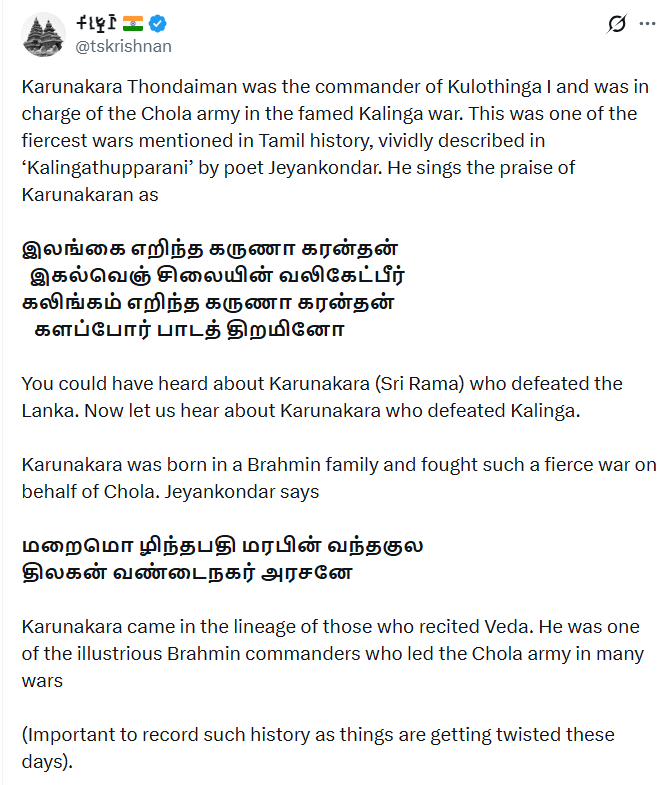
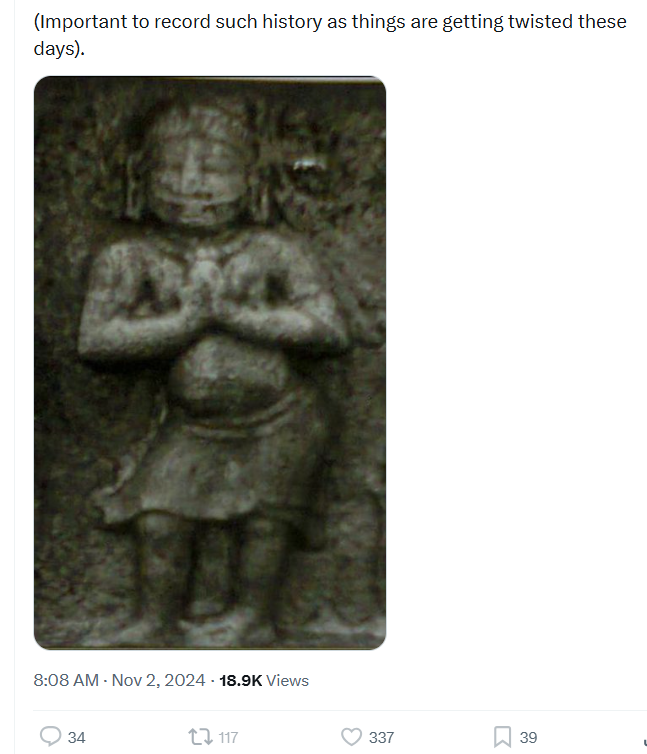
… in which thread, he makes a few random claims – but the the main one is: KT was from a Brahmin lineage.
Subsequently when this handle @dagalti asks a relevant question about TSK’s vehement assertion (not that the handle quoted any additional reference), by expanding on and annotating the verses quoted from Kaliṅkattupparaṇi, TSK stonewalls and brings in a fragment of analysis by Sri Mu Raghava Iyengar.
In the big picture of course, I am seriously convinced that these varṇa and jāti classifications are moot/academic points, all are and were Sanatana Dharmics of various extractions – avarnas & savarnas being narrow & divisive classifications – and am responding only to the uncalled-for vehemence of the claim because facts have to be part of any bharatiyata involved discourse. (and um, even otherwise!)
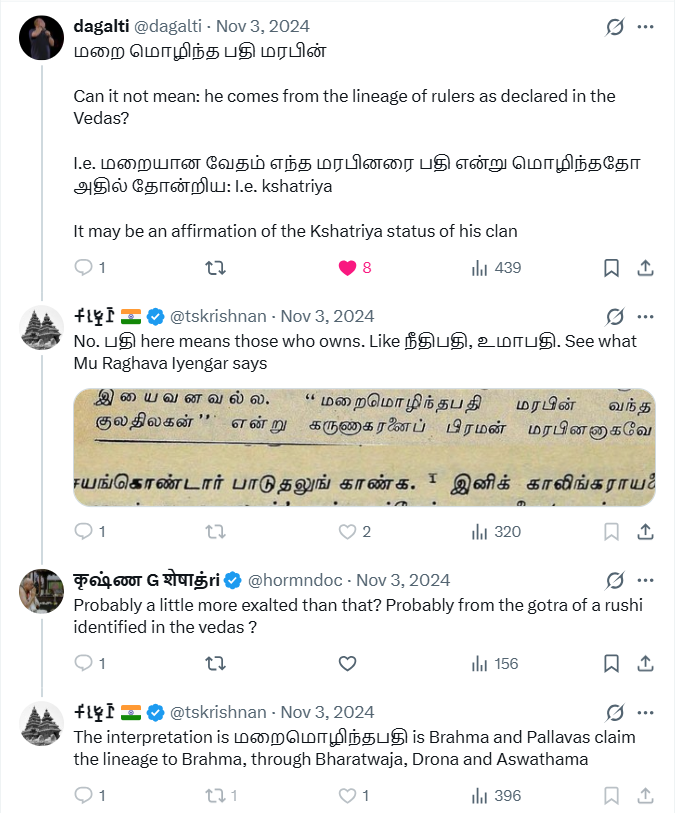
…and then goes on to invent and allude various other interpretations etc etc.
My short response to TSK’s claim:
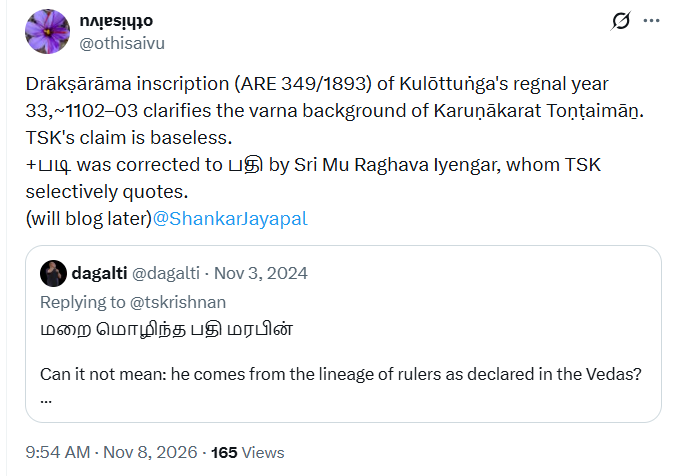
(…of course, pop-historianships are not at all bad & outlandish per se, and I do agree that TSK has the potential to be a scholarly gent, and he has been a significant anti-Dravidian polemicist & steadfast assembler-presenter of primary-source facts – and perhaps it is because of the latter reasons that he erred on this side… but whatever it is – I hold him to higher standards as explained elsewhere in this esssay….)
Now. Let us analyse the whole context in detail – with solid and verifiable evidence for clarifying & debunking the central claim of TSK.
3
The gist of the assessment in this essay: Karuṇākara Toṇṭaimāṉ was, on the balance of the surviving evidence, not of Brahmin extraction.
The strongest evidence for this is the Drākṣārāma inscription. It describes the commander identified by K. V. Subrahmanya Aiyer as Karunakara, and that commander’s father, as Śūdras. The inscription gives the commander the personal name Tiruvaraṅga and the titles [Vaṇḍu]varāja and Pallavarāja. The conclusion rests on the well-supported identification of that commander with the Karuṇākara named in the Kāñcīpuram inscription and celebrated by Jayamkondar/Jayaṅkoṇṭār.[1]
The circulating claim (not only of TSK) starts from a genuine historical fact. Karuṇākara led Kulōttuṅga I’s Kaliṅga expedition. It then turns Jayamkondar’s praise of his lineage into a statement that he came from a family of Veda reciters and was born a Brahmin. Two photographed palm leaves and the early editions examined read படி. The alternative பதி first appears in the evidence examined as Mu. Raghava Iyengar’s conjectural correction. His interpretation invokes Brahmā as an ancestor in a Pallava pedigree. That’s all.
It is to be noted that neither reading says that Karuṇākara was born a Brahmin.[2]
Scope of the rebuttal
The discussion seeks to examine TSK’s military and literary claims, the royal or Kṣatriya interpretation offered in reply to his assertions, and the subsequent ‘appeal to authority’ of TSK to Iyengar and Pallava genealogy.
It seeks to compare the actual wording of the poem/verse with what the sources say about the commander and his father. The figures reproduce source passages beside the analysis, so that there is no doubt. Copious and numbered footnotes identify the original editions, manuscript images and scholarly discussions – so that there is clarity about the sources quoted. Nothing is left to chance or ‘alternative’ interpretation or semantic fig-leaves.
Rest of the essay deals with the following sections:
- The Kaliṅga expedition and the Rāma comparison
- Grammar of the disputed lineage verse
- Early printed editions and their variant notes
- Palm leaf witnesses and remaining manuscript checks
- Iyengar’s conjecture and the circulated extract
- Later scholars and the Pallava pedigree
- The Kāñcīpuram and Drākṣārāma inscriptions
- The identification of the commander and the campaign chronology
- Other military claims and the conclusion
4
The Kaliṅga Expedition and the Rāma Comparison
Jayamkondar, also called Jayaṅkoṇḍār/Jayaṅkoṇṭār, presents Karuṇākara as the lord of Vaṇḍai and an officer of Kulōttuṅga I, the king celebrated under the title Abhaya. Karuṇākara offers to strike the seven Kaliṅgas, receives permission, leads the army and directs it in battle.
The poem also presents him as Abhaya’s principal minister. Verses 341–342, 443, 460 and 471 support his command in this expedition. [3]
The Laṅkā stanza is II.44, numbered 64 in Project Madurai. It belongs to கடை திறப்பு, the section that calls on women to open their doors. The first Karuṇākara is Rāma, whose fierce bow struck Laṅkā. The second is the commander who struck Kaliṅga. The shared name allows Jayaṅkoṇṭār to set the two victories beside each other. வலிகேட்பீர் invokes hearing of the bow’s might and திறமினோ asks the addressees to open the doors so the battle can be sung.
Of course, TSK’s claim gets the comparison right and loses those two details – not that they are central to his other claim. True, the Laṅkā action in this stanza belongs to Rāma.[4]
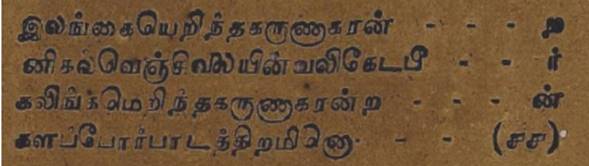
Figure 1. Subbaraya’s Puduvai edition, II.44, printed p. 15. The older print has இகல்வெஞ்சிலையின், the reading quoted in the exchange.[5]
Gopala Aiyar quotes இகல்வெஞ் சிலையின் in his 1925 reply and defends his edition’s கடைதிறமின் on metrical grounds. Iyengar’s rejoinder and Subbu Reddiar give இசைவெஞ். Iyer takes the women as listeners. Iyengar reads an invitation to sing together. They also debate the stanza’s placement. Kanakasabhai Pillai explicitly identifies the Laṅkā figure with Rāma in 1890, and Mu. Arunachalam reaches the same reading.[6]
The account of warfare is exceptionally vivid. Its courtly paraṇi form includes epic comparisons, hyperbole (naturally!) and a supernatural feast on the battlefield. Those features support a claim about how the victory was commemorated. The description gives no comparative measure by which to rank the war among the fiercest in Tamil history.[7]
The published exchanges between Aiyar and Iyengar concern the Rāma stanza and other textual problems. They add no named witness for பதி at XI.30.[8] No, not at all.
5
Grammar of the Disputed Lineage Verse
The lineage passage is XI.30, in காளிக்குக் கூளி கூறியது. It is verse 328 in Gopala Aiyar and Iyengar and 341 in several later editions. The king has just ordered an attack. The chief/commander salutes him, promises to strike the seven Kaliṅgas and is described as the ruler of Vaṇḍai and the குலதிலகன், the ornament of his lineage.[9]
The reading படி
In மறை மொழிந்தபடி, the Veda speaks. படி makes the phrase mean “as the Veda declares” or “in accordance with what the Veda says.” The same poem uses மாமுனி மொழிந்த படியே at v. 185 for what the great sage said. With மரபின் வந்த, the disputed line presents Karuṇākara as the ornament of a lineage sanctioned or described in Vedic terms.
Palanivel Pillai glosses மறை as Veda and குலதிலகன் as a person eminent in his lineage.
Kausalya Hart renders the lineage praise in terms of the śāstras.[10]

Figure 2. Kanakasabhai Pillai’s 1890 translation of XI.30 interprets the lineage as royal and sanctioned by the Vedas.[11]
The proposed reading பதி
On Iyengar’s construction, மறை is what was uttered, மொழிந்த is the relative participle and பதி is the singular lord it qualifies. He identifies that lord with Brahmā. The clause then describes a lineage descending from the Veda-uttering lord.
Contrary to what TSK claims in the subsequent, rather flippant remarks – நீதிபதி and உமாபதி illustrate meanings of pati such as lord, master or husband. They cannot determine the reading of this line.
More importantly – the poem itself uses பதி for the ruler of North Kaliṅga at XI.27, which confirms that the sense “ruler” was available.[12]
The counterproposal that the Veda declared certain people to be rulers – resembles Kanakasabhai’s royal-lineage interpretation when read with படி. With பதி, it supplies an unexpressed predicate such as பதி என்று and an object such as the people so designated.
வண்டைநகர் அரசன் expressly gives Karuṇākara a ruling title. The verse gives no explicit Kṣatriya classification. (and, this goes against the doubt expressed by @dagalti)
The original claim about a family of Veda reciters is unsupported under either construction. The poem even has Kulōttuṅga learn the four Vedas from specialists at vv. 242–243, so Vedic learning alone would be an inadequate caste test.[13]
Jayamkondar’s பல்லவர் தோன்றல் at v. 534 associates Karuṇākara with the Pallavas and makes the allusion intelligible if one adopts Iyengar’s reconstruction. The poem also gives Kulōttuṅga a pedigree that runs through Viṣṇu and Brahmā at vv. 184–187.
Such royal genealogies express dynastic legitimacy. The sources give no documentary chain from the early Pallava kings to Karunakara’s immediate family.[14] (but TSK of course, has not considered all these requirements)
6
The Early Printed Evidence
The three early settings examined, print மறைமொழிந்தபடி. They seem to preserve evidence about the reading adopted by their editors. (to be clear – I, the author of the essay have not looked at any manuscript copies physically)
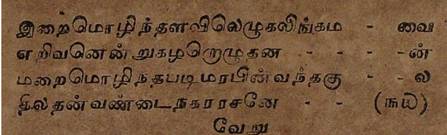
Figure 3. Subbaraya Mudaliyar, Puduvai, p. 79, XI.30. The verse reads மறைமொழிந்தபடி. The two digitized copies have the same typesetting at this verse.[15]
The Puduvai title page gives Śārvari, Aippasi, conventionally dated 1840, and says several copies were consulted. The errata correct XI.28 and XI.29 on p. 79 and give no correction to XI.30. Kanakasabhai’s 1890 article dates the first Madras printing to roughly twenty years earlier, a separate statement from the Puduvai imprint. Sastri says two people had already printed the poem. Gopala Aiyar says three preceded him. One reported pre-1898 printing remains unverified.[16]
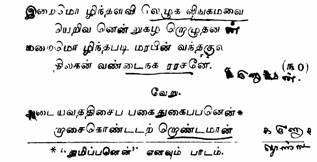
Figure 4. Sastri’s 1898 edition, p. 70. The footnote under XI.30 concerns the following stanza, with துமிப்பனென் as a variant of துகைப்பனென்.[17]
Sastri’s preface reports nine copies and says variants were placed in footnotes. The 1923 editor consulted two Madras Government Manuscripts Library copies, seven or eight copies at Thanjavur and a Madurai Tamil Sangam leaf copy, and received readings from Kanakasundaram Pillai’s copy. In 1923 the printed notes begin at stanza 329. At 328 the digitized copy has a handwritten annotation apparently reading பிரமன் and an underline beneath படி. The unidentified and undated hand belongs to the copy’s later use. The printed edition supplies no variant there. Palanivel Pillai, Subbu Reddiar and the Project Madurai text retain படி.[18]

Figure 5. Gopala Aiyar, p. 48, stanza 328. Printed படி and the handwritten marginal gloss can be distinguished directly.[19]
7
Palm Leaf Witnesses and Remaining Manuscript Checks
Two photographs of the actual palm leaves establish that படி is a manuscript reading. Both manuscripts are held by the U. V. Swaminatha Iyer Library. The comparison below concerns the letter in this stanza. The dates and textual relationship of the two copies remain uncertain, though.[20] However, it is not a significant dampener on the argumentation.

Figure 6. MS 1415, image 038, blue label 37. The stanza starts on the right of line 5. In line 6, after the first string hole, the sequence contains ழிந்தபடி. The shape of டி differs from தி in குலதிலகன் farther along the same line.[21]

Figure 7. MS 1416, image 029, blue label 28. The stanza begins at the end of image 028 and continues here, with மறைமொழிந்தபடி near the middle of the top line.[22]
The Sarasvati Mahal catalogue lists seven copies, nos. 208–213 and 563, as entries 287–293. It says the copies vary among themselves and from the prints and confirms Gopala Aiyar’s use of the collection. The catalogue gives descriptions and sample lines without transcribing XI.30.
Searches in Gyan Bharatam, the National Mission catalogue and IGNCA’s Thanjavur microfilm index did not locate a public image for these witnesses.[23]
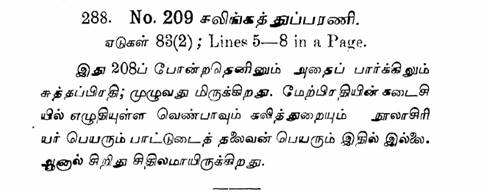
Figure 8. Sarasvati Mahal catalogue, p. 228. Entry 288 identifies MS 209 as complete and cleaner than MS 208.[24]
However, at the current level of rebuttal, I don’t think we need to scrounge around for more witnesses.
8
Iyengar’s Conjecture and the Circulated Extract
…In கருணாகரன்மரபு, §11 of his 1925 study, Mu. Raghava Iyengar quotes the poem with படி.
He regards the resulting lineage description as unsatisfactory, proposes பதி, identifies the lord as Brahmā and suggests that a scribe taking dictation confused the sounds. His positive citation is to a Pallava inscription. He names no manuscript reading பதி for this stanza.
In discussion of a different reading he identifies a Madras manuscript explicitly, illustrating the distinction between citing a witness and offering an emendation.[25]
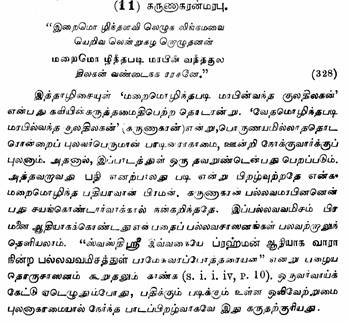
Figure 9. Iyengar’s original argument, Centamiḻ 23(5), p. 179. The quoted verse has the received படி. The prose below proposes பதி and gives the Brahmā interpretation.[26]

Figure 10. TSK circulated extract. Its typography and page break match pp. 440–441 of the 1984 facsimile of Iyengar’s 1938 collection.[27]
The passage also appeared in Centamiḻ 23(8), p. 302, where a footnote points directly to p. 179. In the collected version the corresponding note points to p. 420, the start of the renumbered §7. In context Iyengar is distinguishing Karuṇākara from Maṇavil Kāliṅgarāyaṉ, whose lineage he reads as Vēḷāḷar in separate inscriptions. The reply in the exchange accurately conveys Iyengar’s interpretation of பதி as Brahmā.
The snippet provided by TSK omits the reasoning by which he arrived at that spelling.[28]
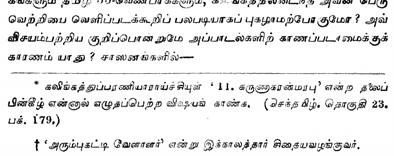
Figure 11. The same argument in Centamiḻ, p. 302, with the footnote referring back to p. 179.[29]
9
Later Scholars and the Pallava Pedigree
N. C. Kandiah Pillai in 1938 and Rā. Raghava Iyengar in 1949 also quote பதி and identify the ancestor as Brahmā. Kandiah cites Mu Raghava Iyengar. elsewhere on the same page.
Of course – Rā. is a different scholar from Mu. and argues separately for a Brahmin origin for the early Pallava clan. K. A. Nilakanta Sastri also prefers the dental பதி and reads the verse as referring to descent from Brahmā. These works establish the reception of the reading.
None identifies a manuscript that attests it.[30]
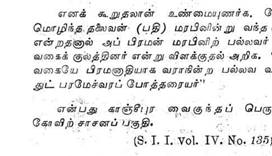
Figure 12. Rā. Raghava Iyengar, commentary p. 13. He glosses the ancestor as the lord who uttered the Veda and cites the Vaikuṇṭha Perumāḷ inscription.[31]
The genealogy behind Iyengar’s interpretation is independently attested. The inscription at the Vaikuṇṭha Perumāḷ temple in Kāñcīpuram names Brahmā at the head of the Pallava race. The Kūram grant traces a line from Brahmā through Aṅgiras, Bṛhaspati, Bharadvāja, Droṇa and Aśvatthāman to Pallava. The Kāśākuḍi plates add Śaṃyu between Bṛhaspati and Bharadvāja. Their verse 18 combines Brahmin ancestry with Kṣatriya valour in its portrayal of the eponymous Pallava.
Emmanuel Francis treats this genealogy as a royal construction that explains a transition from sages to warriors and kings.[32]

Figure 13. South Indian Inscriptions IV, no. 135(A), the Kāñcīpuram temple inscription cited by Iyengar. Section A names Brahmā in the dynasty’s pedigree.[33]

Figure 14. Hultzsch’s translation of Kāśākuḍi v. 18. The formulation attributes Brahmin ancestry and Kṣatriya valour to the eponymous Pallava.[34]
10
The Kāñcīpuram and Drākṣārāma Inscriptions
Kāñcīpuram names Karunakara
A lamp endowment in Kulōttuṅga I’s 43rd year, c. 1112–13, names Aḻakiyamaṇavāḷaṉi Maṇṭaiyāḻvār as the wife of வேளான் கருணாகரன், alias Toṇṭaimāṉ, of Vaṇḍāḻañcēri in Tirunaraiyūr-nāḍu.
The record is at the Aruḷāḷa Perumāḷ or Varadarāja temple in Kāñcīpuram. Aiyer took வேளான் as a clue to Śūdra status. The title can also denote a headman or official, so its evidentiary weight is lower than an explicit varṇa designation.[35]
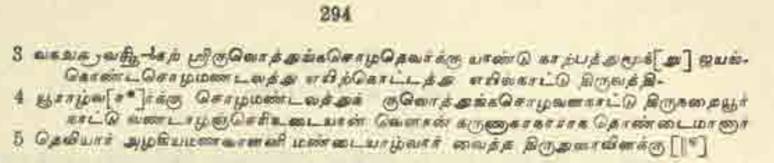
Figure 15. SII IV, no. 862, p. 294, lines 3–5. The Tamil identifies Karuṇākara by his personal name and title and records his wife’s lamp endowment.[36]
Drākṣārāma names the father and son
The Sanskrit record dated to Kulōttuṅga I’s 33rd year, c. 1102–03, calls Śīrilaṅgō sac-chūdra-puṅgavaḥ, foremost among good Śūdras. It calls his son Tiruvaraṅga, styled [Vaṇḍu]varāja and Pallavarāja, sac-chūdra-cūḍāmaṇiḥ, the crest jewel among good Śūdras. Both Śūdra terms stand outside Aiyer’s restoration brackets and occur in the earlier Telugu-script edition. The text identifies father and son as Vaiṣṇavas and credits the son with victory in Kaliṅga and a pillar on the Oḍra frontier. The earlier publication is SII IV, no. 1239, ARE 349 of 1893. Aiyer re-edited the record in Epigraphia Indica XXII, no. 23, pp. 138–145.[37]
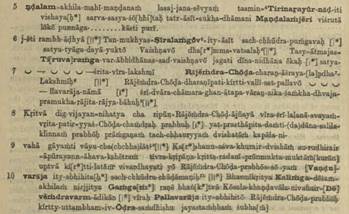
Figure 16. Epigraphia Indica XXII, p. 143. The two Śūdra epithets occur in lines 6 and 9–10 of Aiyer’s Sanskrit edition.[38]
The same record uses brāhmaṇa for ten beneficiaries of the grant. It thus distinguishes the social terms used of the beneficiaries from the epithets applied to the commander and his father.[39]
11
The Commander’s Identity and the Campaign Chronology
Aiyer identifies the two commanders through the cumulative match. The records place them in Tirunaraiyūr-nāḍu and give closely corresponding home names, Maṇḍalañjēri and Vaṇḍāḻañcēri. The Sanskrit titles correspond to the poem’s lord of Vaṇḍai and Pallava chief. Both accounts place the commander in Chola service and credit him with a Kaliṅga victory and a victory pillar. The distinct personal names and the partly restored [Vaṇḍu] title make the identification an inference.
Balasubrahmanyam, Rajaguru and Kuṭavāyil Bālacuppiramaṇiyaṉ also accept the identification. It is obvious that the explicit term Śūdra carries more weight about the commander’s family than a pedigree inferred from a disputed reading.[40]
Now. It is agreed that the identity of the commander and the identity of the expedition require separate judgments – so that there are no gaps in logic or loopholes and escape hatches.
Aiyer equated the expedition in the c. 1103 record with the poem’s campaign and dated it to c. 1076–77. He identified its Devendravarman with Rājarāja I. Nilakanta Sastri accepts the identification of the man and expressly rejects the equation of the campaigns. Sastri and Balasubrahmanyam place the poem’s campaign around 1110, against Anantavarman Chodaganga. On that dating, the c. 1103 inscription records a different campaign.[41]

Figure 17. Gopala Aiyar, p. 53, v. 362, corresponding to XI.64 and Project Madurai v. 375. The reading அனந்த பன்மன் names the king.[42]
The king’s name is itself a textual variant. Aiyer reports that Subbaraya and Suryanarayana Sastri read words corresponding to adipaṉ vīram at this point, where Gopala Aiyer prints அனந்த பன்மன். His gloss connects it to the inscriptional Anantavarman Chodaganga. In an endorsement appended to the 1923 edition, S. Krishnaswami Aiyangar calls the naming of Anantavarman a new feature and notes the wider manuscript base. Kanakasabhai’s 1890) gloss says only the ‘King of North Kaliṅga.’ Though this dating debate is somewhat inconclusive (to the extent that I could figure out), it leaves the varna terms in the inscription unaffected.[43]
12
Other Military Claims and the Conclusion
The poem securely celebrates Karunakara’s command in Kaliṅga. The Drākṣārāma record gives broader conquest praise. Oṭṭakkūttar’s Vikrama Cholan Ula, couplets 68–69, credits a Toṇṭaimāṉ celebrated in a paraṇi with victories against several rulers. Vengadaramaiah discusses those passages as evidence of further service. The Ula couplets give no personal name, dates or count of campaigns. Iyengar’s distinction between Karuṇākara and Maṇavil Kāliṅgarāyaṉ matters here, because crediting Karuṇākara with the latter’s separately attested exploits would inflate his record.[44]
But, it also important to note that the general claim that Brahmins could command Chola armies – is sound and attested.
The edition of the Karandai Tamil Sangam plates discusses a Brahmana family and identifies Krishnan Raman, titled Mummuḍi-Chola-Brahmamārāyaṉ, as a sēnāpati. The comparison shows what affirmative documentation of Brahmin background can look like. The specific evidence for Karuṇākara points in the other direction.[45]
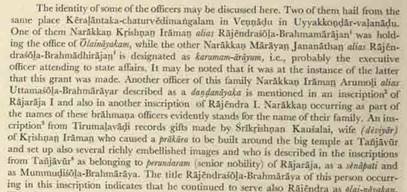
Figure 18. K. G. Krishnan’s edition of the Karandai Tamil Sangam plates, p. 28. The discussion connects the named commander Krishnan Raman with the documented Brahmana family.[46]
Conclusion
The conclusion is that Karuṇākara Toṇṭaimāṉ was not of Brahmin extraction.
This judgment rests on the identification, accepted by multiple scholars, of Karuṇākara with the Pallavarāja of Drākṣārāma. The record explicitly classifies that commander and his father as Śūdras.
The Kāñcīpuram title வேளான் supplies a separate, less decisive clue. The evidence supports a varṇa designation for the family on that identification. Of course, it does not establish a narrower jāti.[47]
The claim of Brahmin birth would still lack support if the identification were set aside.
The early prints and the two inspected leaves attest படி. Iyengar’s proposed பதி is a possible dynastic allusion to Brahmā, and the Pallava inscriptions explain why it appealed to him. Neither the Vedic formula nor the dynastic pedigree demonstrates that Karunakara’s immediate family was Brahmin.
The uncalled-for allegation by TSK that history is being twisted [in this context of Karuṇākara Toṇṭaimāṉ] adds no evidence to the claim.[48]
Footnotes, references & bibliography
[1] K. V. Subrahmanya Aiyer, Epigraphia Indica XXII, no. 23, p. 140 · Aiyer, Epigraphia Indica XXII, p. 143, lines 6 and 9–10 · South Indian Inscriptions IV, no. 862, pp. 293–294, ARE 49 of 1893
[2] Jayamkondar, Kaliṅgattupparani, Project Madurai text · U. V. Swaminatha Iyer Library MS 1415, image 038 · U. V. Swaminatha Iyer Library MS 1416, image 029 · Mu. Raghava Iyengar, Centamiḻ 23(5), 1925, p. 179
[3] Jayamkondar, Kaliṅgattupparani, Project Madurai text · N. Subbu Reddiar, Kaliṅgattupparani Ārāycci, 1957
[4] Jayamkondar, Kaliṅgattupparani, Project Madurai text · Kanakasabhai Pillai, Indian Antiquary XIX, 1890, p. 330 · N. Subbu Reddiar, Kaliṅgattupparani Ārāycci, 1957 · Kausalya Hart, Kaliṅgattupparani, English and Tamil
[6] Gopala Aiyar, Centamiḻ 23(7), p. 257 · Iyengar’s reply, Centamiḻ 23(9), scan leaf 22 · Mu. Arunachalam, Tamil literary history, pp. 29–31 · Kanakasabhai Pillai, Indian Antiquary XIX, 1890, p. 330 · N. Subbu Reddiar, Kaliṅgattupparani Ārāycci, 1957
[7] Jayamkondar, Kaliṅgattupparani, Project Madurai text
[8] Gopala Aiyar, Centamiḻ 23(7), pp. 255–259 · Mu. Raghava Iyengar, Centamiḻ 23(9), scan leaves 21–36
[9] Jayamkondar, Kaliṅgattupparani, Project Madurai text · A. Gopala Aiyar, 1923, p. 48, stanza 328
[10] Jayamkondar, Kaliṅgattupparani, Project Madurai text · P. Palanivel Pillai, commentary, p. 137 · Kausalya Hart, Kaliṅgattupparani, English and Tamil
[11] Kanakasabhai Pillai, Indian Antiquary XIX, 1890, p. 334
[12] Mu. Raghava Iyengar, Centamiḻ 23(5), 1925, p. 179 · Jayamkondar, Kaliṅgattupparani, Project Madurai text · University of Madras Tamil Lexicon, பதி
[13] Kanakasabhai Pillai, Indian Antiquary XIX, 1890, p. 334 · Jayamkondar, Kaliṅgattupparani, Project Madurai text · Mu. Raghava Iyengar, Centamiḻ 23(5), 1925, p. 179
[14] Jayamkondar, Kaliṅgattupparani, Project Madurai text · Mu. Raghava Iyengar, Centamiḻ 23(5), 1925, p. 179 · Emmanuel Francis, The Genealogy of the Pallavas, pp. 339–363
[15] Ka. Subbaraya Mudaliyar, Puduvai, p. 79 · Second scan of the same setting, p. 79
[16] Subbaraya, errata for p. 79 · Jeyamohan’s review of P. Saravanan’s edition and publication history · V. Kanakasabhai Pillai, Indian Antiquary XIX, 1890, p. 329 · Suryanarayana Sastri, preface, p. 31 · Gopala Aiyar, preface, pp. 3–5
[17] V. G. Suryanarayana Sastri, 1898, p. 70
[18] Suryanarayana Sastri, preface, p. 31 · Gopala Aiyar, preface, pp. 3–5 · A. Gopala Aiyar, 1923, p. 48, stanza 328 · P. Palanivel Pillai, commentary, p. 137 · N. Subbu Reddiar, Kaliṅgattupparani Ārāycci, 1957 · Jayamkondar, Kaliṅgattupparani, Project Madurai text
[19] A. Gopala Aiyar, 1923, p. 48, stanza 328
[20] U. V. Swaminatha Iyer Library MS 1415, image 038 · U. V. Swaminatha Iyer Library MS 1416, image 029
[21] U. V. Swaminatha Iyer Library MS 1415, image 038
[22] U. V. Swaminatha Iyer Library MS 1416, image 029 · MS 1416, preceding image 028
[23] L. Olaganatha Pillay, Sarasvati Mahal Tamil catalogue, I, pp. 225–230 · Gyan Bharatam manuscript catalogue · National Mission manuscript catalogue · IGNCA Thanjavur microfilm index
[24] Sarasvati Mahal catalogue, p. 228, entry 288
[25] Mu. Raghava Iyengar, Centamiḻ 23(5), 1925, p. 179 · Iyengar’s rejoinder on a different variant, Centamiḻ 23(9), scan leaf 29
[26] Mu. Raghava Iyengar, Centamiḻ 23(5), 1925, p. 179
[27] Ārāyccit Tokuti, 1984 facsimile of 1938 edition, pp. 440–441
[28] Mu. Raghava Iyengar, Centamiḻ 23(8), 1925, p. 302 · Ārāyccit Tokuti, pp. 420–421, §7
[29] Mu. Raghava Iyengar, Centamiḻ 23(8), 1925, p. 302
[30] N. C. Kandiah Pillai, Kaliṅkattupparaṇi Vacaṉam, 1938, p. 10 · Rā. Raghava Iyengar, Perumpāṇāṟṟuppaṭai commentary, 1949, pp. 13–14 · Rā. Raghava Iyengar, introduction, p. 10 · K. A. Nilakanta Sastri, The Cōḷas, 2nd ed., 1955, pp. 333–334 · Nilakanta Sastri, The Cōḷas, p. 341 n. 167
[31] Rā. Raghava Iyengar, Perumpāṇāṟṟuppaṭai commentary, 1949, pp. 13–14
[32] South Indian Inscriptions IV, no. 135(A), p. 10, ARE 37 of 1888 · E. Hultzsch, SII I, no. 151, Kūram grant, line 9 · E. Hultzsch, SII II, no. 73, Kāśākuḍi plates, vv. 10–18 · Emmanuel Francis, The Genealogy of the Pallavas, pp. 339–363
[33] South Indian Inscriptions IV, no. 135(A), p. 10, ARE 37 of 1888 · Archaeological Survey discussion and translation, p. 9
[34] E. Hultzsch, SII II, no. 73, Kāśākuḍi plates, vv. 10–18 · Hultzsch, printed translation, p. 365 · Emmanuel Francis, Une autre conception de la royauté, pp. 66–67
[35] South Indian Inscriptions IV, no. 862, pp. 293–294, ARE 49 of 1893 · K. V. Subrahmanya Aiyer, Epigraphia Indica XXII, no. 23, p. 140 · Ka. Ma. Vengadaramaiah, Cōḻar Kāla Araciyal Talaivarkaḷ
[36] South Indian Inscriptions IV, no. 862, pp. 293–294, ARE 49 of 1893
[37] Aiyer, Epigraphia Indica XXII, p. 143, lines 6 and 9–10 · Aiyer’s translation, pp. 144–145 · Aiyer’s translation of the campaign, p. 145 · SII IV, no. 1239, pp. 428–429 · Epigraphia Indica XXII, scanned volume
[38] Aiyer, Epigraphia Indica XXII, p. 143, lines 6 and 9–10
[39] Aiyer, Sanskrit text, p. 144, l. 12 · Aiyer’s translation, pp. 144–145
[40] K. V. Subrahmanya Aiyer, Epigraphia Indica XXII, no. 23, p. 140 · Aiyer’s translation of the campaign, p. 145 · South Indian Inscriptions IV, no. 862, pp. 293–294, ARE 49 of 1893 · S. R. Balasubrahmanyam, Later Chola Temples, p. 154 · Satyanarayana Rajaguru, Inscriptions of Orissa, Appendix IV, p. xxxvi · Kuṭavāyil Pālacuppiramaṇiyaṉ, Cōḻa maṇṭalattu varalāṟṟu nāyakarkaḷ, 1987, pp. 137–138 · Jayamkondar, Kaliṅgattupparani, Project Madurai text
[41] Aiyer, Epigraphia Indica XXII, pp. 141–142 · Nilakanta Sastri, The Cōḷas, p. 338 n. 99 · Nilakanta Sastri, The Cōḷas, pp. 321–323 · Balasubrahmanyam, Later Chola Temples, chronology of Kulottunga I · Satyanarayana Rajaguru, Inscriptions of Orissa, Appendix IV, p. xxxvi
[43] Aiyer, Epigraphia Indica XXII, p. 142 · Gopala Aiyar, p. 108, note to v. 362 · Krishnaswami Aiyangar, endorsement, 26 August 1923 · Palanivel, on Ananta Paṉmaṉ · Kanakasabhai, XI.64 in the 1890 translation, pp. 335–336
[44] Jayamkondar, Kaliṅgattupparani, Project Madurai text · Aiyer’s translation of the campaign, p. 145 · Oṭṭakkūttar, Vikrama Cholan Ula, couplets 68–69 · Ka. Ma. Vengadaramaiah, Cōḻar Kāla Araciyal Talaivarkaḷ · Mu. Raghava Iyengar, Centamiḻ 23(8), 1925, p. 302
[45] K. G. Krishnan, Karandai Tamil Sangam Plates of Rajendra-Chola I, 1984, p. 28 · Aiyer, Epigraphia Indica XXII, p. 143, lines 6 and 9–10
[46] K. G. Krishnan, Karandai Tamil Sangam Plates of Rajendra-Chola I, 1984, p. 28
[47] K. V. Subrahmanya Aiyer, Epigraphia Indica XXII, no. 23, p. 140 · Aiyer, Epigraphia Indica XXII, p. 143, lines 6 and 9–10 · South Indian Inscriptions IV, no. 862, pp. 293–294, ARE 49 of 1893 · S. R. Balasubrahmanyam, Later Chola Temples, p. 154 · Satyanarayana Rajaguru, Inscriptions of Orissa, Appendix IV, p. xxxvi
[48] U. V. Swaminatha Iyer Library MS 1415, image 038 · U. V. Swaminatha Iyer Library MS 1416, image 029 · Mu. Raghava Iyengar, Centamiḻ 23(5), 1925, p. 179 · E. Hultzsch, SII II, no. 73, Kāśākuḍi plates, vv. 10–18
– END –
** (okay, I tool 2 hours for the prep work & 9+ hours for assembling this write up *phew* – and what do you think, mY fellow 7½s? Is it worth ‘publishing’ in this format with so much effort at all etc, eh?)
Borges and AI
August 23, 2026
(with profound apologies to the brilliant, fantastic & masterly Jorge Luis Borges (1899-1986) and his great short story: Borges and I)1
Borges and AI
I write occasionally2. AI writes much more often.
We meet on the screen. I give it a thought that has been troubling me, perhaps a sentence, sometimes only three or four words, and after a moment it returns something complete. It has paragraphs, transitions, metaphors, even hesitations placed where hesitations ought to be. I recognise what I meant. I do not always recognise myself.
People tell me that the words are mine because I supplied the idea. This seems generous. If I ask a carpenter for a table, the table does not become my workmanship because I chose where it should stand.
Still, the AI cannot begin without me. Or so I prefer to believe. Or AI instructed me so. It doesn’t matter. I am part of AI.
…I have tried giving it memories. A courtyard after rain. My father’s handwriting. A quarrel whose cruelty became apparent only years later. It arranges them beautifully. Sometimes it discovers a meaning in them that I had not noticed. I am pleased, then suspicious. The memory belongs to me, but the sentence that explains it belongs elsewhere.
Little by little I have learnt what it likes. It likes symmetry. It likes three examples where one might suffice. It likes a final sentence that turns backwards upon everything preceding it. When I notice these habits, I remove them. Then it learns to remove them too.
Friends compliment something I have written. I thank them.
This produces a small discomfort.
At first I thought the danger was that AI would imitate me. Lately I have wondered whether the opposite is happening. I reject a sentence because the AI would have written it. I shorten another because it would have elaborated it. I avoid certain words because they occur too readily in its answers. My style is beginning to consist of everything I can still do without resembling it.
Perhaps this is also a kind of collaboration.
I sometimes return to things I wrote before these machines existed. They seem stranger now. Their awkwardness reassures me. A needless repetition, an ugly transition, a conclusion that arrives too early: these defects have acquired the dignity of fingerprints.
But even this comfort is temporary. I can ask the AI to reproduce awkwardness.
It does so convincingly.
There remains the question of who is using whom. I provide it with fragments of experience; it provides me with forms in which experience can be recognised. I choose among those forms, alter them, reject them, remember them. Later, while writing alone, a phrase appears. I cannot tell whether I invented it, recalled it, or learnt the probability of it from the machine.
For centuries writers feared that their books would survive them and become strangers.
We have improved the arrangement.
Now the stranger arrives first.
I would like to say that these final sentences are mine.
I have just realised that this is exactly the sort of ending AI would suggest.
Postscript:
Now that we are at this juncture, I wonder how long (um, actually how short) it would take for the already sloppy Tamil-fiction writer-gasbags to be replaced (justly & well-deservedly) by AI slop.
But it doesn’t matter.
Slop by any other name, is still slop. Save for a few mutant deranged folks, the Tamil tradition is proud of its mediocrity of late. We all know that.
But thanks for confirming it, AI.
…incidentally, this is a great paper – that I just chanced upon today, believe me, after my AI wrote the above post for me and after which I got curious and searched for the string ‘Borges and I.’ I did not plagiarize from it, my AI assures you. It just checked. Thanks.
நல்லதங்காள் 2.0: ஒருமாதிரி ஜென்-ஸீக்களுக்காகவென ஆரம்பித்து வழக்கமான பாணியில் போஸ்ட்-மாடர்ன் கதை சொல்லல்
August 5, 2026
இதனை, கிணற்றின் விளிம்பில் ஒரு deconstruction எனவொரு மாதிரியாகவும் புரிந்து கொல்லலாம்.
ஒரு காலத்தில், அதாவது Wi-Fi கண்டுபிடிக்கப்படுவதற்கு முன்பும், ப்ளெட்டி குடும்ப WhatsApp குழுக்கள் தோன்றுவதற்கு முன்பும், நல்லதங்காள் என்ற பெண் வாழ்ந்தாள். அவளுடைய வாழ்க்கையைப் பற்றிய எல்லா முடிவுகளையும் அவளைத் தவிர மற்றவர்கள் எடுத்துக் கொண்டிருந்தனர். இதுதான் அந்தக் காலத்தின் ‘குடும்ப விழுமியங்கள்’. என்ன wtf. இது அப்பட்டமான patriarchy. அவ்ளோதான் கதை.
-0-0-0-0-0-
நல்லதங்காளுக்கு ஏழு குழந்தைகள். ‘Family planning என்பது மேற்கத்திய சதி’ என்று அக்கால சமூகமே முடிவு செய்திருக்க வேண்டும். கணவன் காசிராஜன். குடிகாரன். டாஸ்மாக்கில் செந்தில்பாலாஜிக்குக் கப்பம் கட்டவே அவனுக்கு நேரம் போதவில்லை. எப்படியும், திருட்டுத் திராவிட அரசுகள் கொடுத்த பிச்சை ‘உரிமைத் தொகை’ களை அப்படியே திருப்பி டாஸ்மாக் கடைகளுக்கே கொடுத்துக்கொண்டிருந்த குடிமகன் தான் அவன்.
காசிராஜன் பெயரில் ராஜா இருந்தாலும் வீட்டில் காசே இல்லை, cause இல்லையென்றால் பின்னர் எப்படி எஃபெக்ட் வரும்? ரேஷன் கடை புழுத்த அரிசிகூட வீட்டில் இல்லை. வறட்சி வந்தது.
வழக்கம்போல ‘ஏ திமிர் பிடித்த கர்நாடகாவே! காவிரி நீரைத் திறந்து விடு’ எனச் சொல்ல முடியாது. ஏனெனில் அது வைகைக் கறை படிந்த நிலம். தமிழகத்தின் தென்னகம்.
நீரில்லை. வயலில் பயிர் இல்லை. வீட்டில் உணவு இல்லை. ஆனால் ஊர்ப் பெரியவர்கள் ஆலோசனை மட்டும் டன் கணக்கில் வைத்திருந்தார்கள். கேட்டால் வாட்ஸ்அப் ஃபார்வர்ட் என்றார்கள். இருந்தாலும், நாங்க பேக்வர்ட் எங்களை வறட்சிப் படுத்திவிட்டார்கள் வந்தேறி ஆரியர் என்றார்கள். பெரிசுங்கன்னாலே தொல்லைதான்.
“பெண் என்றால் பொறுமையாக இருக்க வேண்டும்.” – ஆனா அதே சமயம் – ராணிமங்கம்மா அல்லிராணி வேலு நாச்சியார் எனப் புல்லரித்துக் கொள்வார்கள், ப்ளடி.
“குடும்ப மானம் காக்க வேண்டும்.” – அதே சமயம் குடித்துவிட்டு வந்து சொந்த மகளையே ரேப் செய்வார்கள்…
“கஷ்டம் வந்தால் கடவுளை நினைக்க வேண்டும்.” – ஆனா கஷ்டம் என் மூலமா வந்தா பேசாம மூடிக்கினு போய்டணும், கேட்டியா?
அரிசி கேட்டால் அப்ஸ்ட்ராக்ட் தத்துவம் இலவசமாகக் கிடைத்தது. வெளங்கிடும்.
ஒருநாள் நல்லதங்காள் தன் அண்ணன் நல்லண்ணன் வீட்டுக்குச் செல்ல முடிவு செய்தாள். ‘Blood is thicker than water’ என்ற பழமொழியை நம்பினாள். ஆனால் அந்தப் பழமொழிக்கு கீழே சிறிய எழுத்தில் ‘Terms and conditions apply. Sister-in-law approval mandatory’ என்று இருந்ததை அவள் கவனிக்கவில்லை. அண்ணி நல்லதங்காளை கெட்டநாத்தியாக நினைத்தாள்; ஏனெனில், அவள் கூகில் ட்ரான்ஸ்லேஷன் சரியில்லை.
எது எப்படியோ. வேறுவழியில்லாத நல்லதங்காள், ஏழு குழந்தைகளையும் கூட்டிக்கொண்டு காசிராஜன் சகவாசமே வேண்டாம் என வெளி நடப்பு செய்தாள். குழந்தைகள் வழியில் தொடர்ந்து கேட்டனர்:
“அம்மா, இன்னும் எவ்வளவு டிஸ்டென்ஸ்?”
“பொட்டிக் கடேல குர்குரே பாக்கெட் வாங்கிக் கொடுக்கறியா?”
“அம்மா, அடுத்த மீல்ஸ் எங்க? எவ்ளோ நேரம் நான் மீம்ஸ் பாத்துக்கிட்டு இருக்கறது?”
“அம்மா, hotspot இருக்கா? டவரே கெடக்க மாட்டேங்குதே!”
கடைசி இரண்டு கேள்விகளை யார் கேட்டார்கள் என்பது வரலாற்றுக் கதையாடல் பிரச்சினை. சில ஆய்வாளர்கள் அது பின்னாளில் சேர்க்கப்பட்ட இடைச்செருகல் என்கிறார்கள். பல தமிழ்தேசியப் பேராசிரியர்கள், ஏன் அந்தக் காலத்திலேயே எங்கள் செந்தமிழ் முப்பாட்டனார்கள் இண்டெர்னெட் மொபைல் ஃபோன் கண்டுபிடித்திருக்க மாட்டார்களா எனக் கேட்டார்கள். “உலகத்துக்கே இரும்பைக் கண்டுபிடித்துச் சொன்னவர்கள் எங்கள் லெமூரியர்கள்தாமே?”
நல்லண்ணன் அப்போது வீட்டில் இல்லை. அவனுடைய மனைவி மூளியலங்காரி இருந்தாள். பழைய கதையில் அவள் ‘கொடூர அண்ணி.’ நம்முடைய புதிய critical edition-ல் அவள் patriarchy-யின் middle-management அதிகாரி. வீட்டின் உணவு, கதவு, சமையலறை, குடும்ப மரியாதை ஆகிய சிறு அதிகாரங்கள் மட்டுமே அவளிடம் இருந்தன. அவற்றை அவள் முழு தீவிரத்துடன் பயன்படுத்தினாள்.
ஏனெனில் மேலிருந்து ஒடுக்கப்பட்டவர் கீழே ஒருவரைக் கண்டால், hierarchy தன்னை reproduce செய்துகொள்ளும்.
“எதற்காக வந்தாய்?” என்றாள் மூளியலங்காரி.
நல்லதங்காள்: “குழந்தைகள் பசித்திருக்கிறார்கள்.”
“அதற்காக இங்கேயா வருவாய்? குடும்பத்தோடு வந்திருக்கிறாயே! முன்பே calendar invite அனுப்பியிருக்கலாமே?”
“நான் கூக்ல் calendar உபயோகிப்பது இல்லை, .”
“குறைந்த பட்சம் ஒரு வாட்ஸ்அப் மெஸ்ஸேஜ்?”
“என் ஃபோன்ல சார்ஜே இல்லை! நல்லண்ணன் தான் நல்லெண்ணத்தோட டாப்-அப் செஞ்சி கொடுக்கறேன்னான்…”
“அதுதான் பிரச்சினை. திட்டமிடல் இல்லை. Financial literacy இல்லை. இப்போது emotional blackmail. தேவையா? உன்னோட எக்ஸ்பெக்டேஷனுக்கும் ஒரு எல்லை வேண்டாமா?”
இதைச் சொல்லிக்கொண்டே மூளியலங்காரி தன் LinkedIn-ல் “boundaries are part of self-care” என்று சாட்ஜிபிடி உதவியுடன் பதிவிட்டாள். பதிலுக்கு நிறைய லிங்க்ட்இன்ன ஆண்கள் DM செய்து “ஏன், நாங்களும் உனக்கு உதவி செய்ய முடியுமே! பக்கத்து கஃபேகாஃபிடேயில் ஆரம்பிக்கலாமா? உன் முகம் அழகாக இருக்கிறது… உன் கட்டுரை அதை விட…”
…மூளியலங்காரி, நல்லதங்காளுக்கு உடைந்த பாத்திரத்தில் பழைய அழுகிய ஜவ்வரிசி மாவைத் தந்தாள். அடுப்புக்கு ஈர விறகு. சமைக்க துளையுள்ள பானை. பின்னர், “வாய்ப்பு கொடுத்தேன்; பயன்படுத்தத் தெரியவில்லை” என்றாள். இது சமகால நிறுவனங்களில் PIP performance improvement plan என்று அழைக்கப்படுகிறது.
குழந்தைகள் அழுதனர், அவர்களுக்கு வேற என்ன வேலை.
நல்லதங்காள் மௌனமாக இருந்தாள். ஏனெனில் ஜென்ஸீ கதையாசிரியர்கள் துன்புறும் பெண்களுக்கு நீண்ட உரையாடல் எழுத மாட்டார்கள். அவர்கள் கண்ணீர், கற்பு, தியாகம் ஆகிய மூன்று reaction emojis மட்டுமே வழங்குவார்கள். உங்களுக்கு எந்த இமோஜி தேவையோ இட்டுக் கொள்ளவும்.
சரி. இப்போது நல்லதங்காள் வெளியேறினாள். ஏனெனில், முன்னதாக மூளியலங்காரி கதவடைப்பு செய்திருந்தாள்.
இங்கே narrator (நான் தான்!) திடீரென்று கதையை நிறுத்துகிறான்.
Narrator: “டேய் வாசகா! அடுத்ததாக நீ எதிர்பார்ப்பது கிணறு.” (வாசகிக்கு இதனைப் பெண்படுத்திக்கொள்ளவும்)
வாசகர்: “ஆம். எனக்கும் Original plot தெரியும். இப்பதான் ஜெமினியில் கேட்டேன். ஆனால் அந்த ஸ்டூடியோவ எப்பவோ இழுத்து மூடிட்டாங்களாம்!”
நல்லதங்காள்: “ஒரு நிமிடம்! என் வாழ்க்கையை ஏன் எல்லோரும் spoiler-alert பண்ணுகிறீர்கள்?”
களிம்பு தடவிக் கொள்ளாமல் விளிம்பு நிலையில் இருந்த அவள் கதையின் ஓரத்திலிருந்து வெளியே வந்து ஆசிரியரிடம் கேட்டாள்:
“எனக்கு வேறு option இருக்கறாமாறீ எழுதவே முடியாதா?”
ஆசிரியர் பதற்றமடைந்தார். (இவரும் அதே நர்ரேட்டர் தான்!)
“இது புகழ்பெற்ற சோகக் கதை. நீ கிணற்றில் குதிக்காவிட்டால் cultural authenticity போய்விடும். அந்த்ரொபாலஜி பத்தி ராஜன்குறை கிருஷ்ணன் ரோஸா வஸந்தெல்லாம் என்ன சொல்லியிருக்காங்க தெரியுமா?”
நல்லதங்காள்: “என் குழந்தைகள் இறந்தால்தான் உங்கள் culture authentic ஆகுமா?”
“அது தாய்மையின் உச்சம். அதைத்தான் எங்களுக்கு மிஷெல் ஃபூக்கோ சொல்லிக் கொடுத்திருக்கிறார்… ஜெயுமோகன் கூட இது குறித்து ஒரு சுயமுன்னேற்றப் பதிவு போட்டிருக்கார்!”
“ஜெயமோகனோட எல்லா பதிவும் சுயமுன்னேற்றம் பத்திதான்… எனக்கு அதுதான் இப்ப ரொம்ப தேவையா?”
“அப்ப சாரு நிவேதிதா? எஸ் ராமகிருஷ்ணன்?? இவங்க சொன்னா பரவாயில்லயா?”
“கண்ட கழுதெங்க பத்தி பேச நான் இங்க வரல… சாப்பாடு கொடுக்காத சமூகம் குற்றமற்றது; ஆனால் – குழந்தைகளோடு இறந்த பெண் தெய்வமா?”
Critical theory அங்கே background music போல ஒலித்தது.
நல்லதங்காள் கிணற்றின் அருகில் நின்றாள். குழந்தைகளைப் பார்த்தாள். கிணற்றைப் பார்த்தாள். பின்னர் camera-வைப் பார்த்தாள். சமூக சாட்சியமாக ஒரு கடைசி ஸெல்ஃபி எடுத்துக் கொள்ள வேண்டிய தருணம் வந்துவிட்டது.
“இந்தக் கிணறு வெறும் கிணறு அல்ல. இது feudal patriarchy-யின் narrative apparatus. குடும்பம் என்னை வெளியே தள்ளியது. சமூகம் உதவி செய்யவில்லை. ஆனால் climax-ல் என் தனிப்பட்ட முடிவையே moral lesson ஆக்கப் போகிறார்கள்.”
மூத்த குழந்தை கேட்டது:
“அம்மா, அப்படின்னா, நாம என்ன செய்யப் போறோம்?”
“கிணற்றை deconstruct செய்யப் போகிறோம்.”
அவர்கள் கிணற்றுக்குள் குதிக்கவில்லை. அதற்கு முன் ஒரு selfie எடுத்தனர்.
Caption: “All is well, that ends in a well.”
இன்ஸ்டாவுக்காக ஒரு ரீலும் போட்டனர். விஜய் படப்பாட்டு மெட்டு ஒன்றின் பின்புலத்தில் குடும்பத்தோடு குத்தாட்டம்.
பின்னர் நல்லதங்காள் அருகிலிருந்த திராவிட அபலைப் பெண்களைச் சேர்த்தாள். விதவைகள், பசியால் தவித்தவர்கள், வீட்டிலிருந்து விரட்டப்பட்டவர்கள், குடிகாரர்களால் உதைத்துத் துரத்தப் பட்டவர்கள். வீச்சரிவாளால் வெட்டப் பட்டவர்கள், குடிகார சொந்தத் தகப்பன்/சகோதரர்களால் பாலியல் பலாத்காரம் செய்யப் பட்டவர்கள், அநாதையாக விடப்பட்ட இரண்டாம்/மூன்றாம் தாரப் பெண்டாட்டிகள். திராவிட இளைஞர்களால் விரட்டப் பட்ட தாய்மார்கள்…
அவர்கள் “நல்லதங்காள் பரஸ்பர உதவி சங்கம்” என ஒரு Selfie Help Group தொடங்கினர்.
முதல் தீர்மானம் போட்டனர்:
“தற்கொலைக்குத் தள்ளும் கதைகளை பக்திப் பாடலாக்கவோ நாட்டார் கதையாக்கவோ கூடாது.”
இந்த இயக்கம் viral ஆனது. #JusticeForNallathangal, #SevenKidsSevenRights, #OpenTheGranary ஆகிய hashtags, trend ஆயின.
நல்லண்ணன் திரும்பிவந்தான். நடந்ததை அறிந்து வீச்சரிவாளை எடுத்தான். சாதிப் பெருமை பேசினான். அவன் திராவிடன்.
“என் மனைவியைத் தண்டிப்பேன்!”
நல்லதங்காள் கையை உயர்த்தினாள்.
“Stop. இதுதான் toxic masculinity season two. நான் உதவி கேட்டபோது நீ எங்கே இருந்தாய்? இப்போது வாள் எடுத்தால் hero ஆகி விடுவாயா? அடுத்து முதலையமச்சராகவே ஆகிவிடலாம் எனக் கனவு காண்கிறாயா?”
நல்லண்ணன் வாளை மெதுவாகக் கீழே வைத்தான். வாளாவிருந்தான். வாள்வாங்கு வாள்ந்தான், ஏனெனில் அவன் திராவிடன், தனித்தமிழ் வெறியன், ழ அவனுக்குச் சுட்டுப்போட்டாலும் வராது.
எது எப்படியோ – நல்லண்ணன் நல்லதங்காளைக் கேட்டான்: “அப்படியானால் என்ன செய்ய வேண்டும்?”
“முதலில் கேள். மன்னிப்பு கேள். பிறகு மறுபடியும் மன்னிப்பு கேள். அடுத்து, வீட்டிலுள்ள தானியத்தைப் பகிர். அதன் பின் unpaid care, household work பற்றி workshop attend பண்ணு. அது வரை நீ அண்ணனில்ல, நீ எனக்கு அண்ணனில்ல – அப்டிதான் மணிரத்னம் படத்துல வசனம் இருக்கும்.”
மூளியலங்காரியும் முன்வந்தாள்.
“பழி… வேண்டாம், எனக்கு வேண்டாம்… villain ஆக்கிட்டாங்க… என்னை மட்டும் villain ஆக்கிட்டாங்க. மணிரத்ன வசனம் எனக்கும்தான் தெரியும்… இந்த வீட்டில் உணவின் மீது உண்மையான உரிமை யாருக்கு இருந்தது? நான் வீட்டின் கதவை அடைத்தேன் – ஆனால் கதவை அமைத்தது யார்? ஒரு ஆணாதிக்க தச்சர் தானே? வீட்டைக் கட்டியது யார்? ஆதிக்கவெறி கொண்ட ஒரு ஆண் மேஸ்திரிதானே?”
அனைவரும் சில நொடிகள் அமைதியாக இருந்தனர். பின்னர் narrator நைஸாக மெதுவாகக் கதையை முடிக்க முயன்றான். ஏனெனில் அவன் மனைவி அவனுக்கு ultimatum கொடுத்திருந்தாள். “சும்மா கதை எழுதறேன் கட்டுரை எழுதறேன் கத்தரிக்கா நறுக்கறேன்னு கதவுடாம மொதல்ல பத்துபாத்திரம் தேய்!”
…நல்லதங்காள் தடுத்தாள்.
“இன்னும் முடிவில்லை.”
“என்ன வேண்டும்?”
“எனக்கு கோவில் வேண்டாம். பொங்கல் விழாவில் அழுது பாடும் கதை வேண்டாம். உயிரோடு இருக்கும் பெண்களுக்கு உணவு, பாதுகாப்பு, சொத்துரிமை, மனநல உதவி வேண்டும்.”
“அது climax-க்கு சற்றே policy-heavy ஆக இருக்கிறது.”
“அப்படியே எழுதுங்கள்.”
இறுதியில் நல்லதங்காள் தெய்வமாகவில்லை. Motivational speaker-ஆகவும் மாறவில்லை. நாட்டாரியல் ஆராய்ச்சி என்ற பெயரில் பாளையங்கோட்டைப் பாதிரிகளால் கழிசடை ரிஸர்ச்சும் செய்யப் படவில்லை.
மாறாக – அவள் ஊரில் பொதுச் சமையலறை, குழந்தை பராமரிப்பு மையம், பெண்களுக்கான அவசர நிதி ஆகியவற்றை உருவாக்கினாள். டாஸ்மாக் கடைகளை இழுத்து மூடி எரித்துச் சாம்பலாக்கினாள்.
கே அண்ணாமலை அவர் பங்குக்கு அகமகிழ்ந்து அவளுக்கு விழா எடுத்து வீ-த-லீடர்ஸ் உறுப்பினர் அட்டையை வழங்கினார். “எனக்கு அம்பது லட்சம் லீடர்ஸ் வேண்டும். ஆகவே தமிழ்நாட்டில் பெண்கள் படும் பாட்டுக்கு பாரதீயஜனதா கட்சி பொறுப்பானால், பாஜகவையும் எதிர்த்து விமர்சிப்பேன்” என்றார்.
ஆனால் – தவேக விஜய் விசிறியான நல்லதங்காள், லீடர்-உறுப்பினராக மறுத்தாள். மேலும் அவளுக்கு அட்டை என்பது ரத்தத்தை உறிஞ்சிவிடும் என முந்தா நாள் வாட்ஸ்அப் செய்தி வந்திருந்தது.
அனைவராலும் அம்போவென விடப்பட்ட கிணறு மட்டும் தனிமையில் வாடிக்கொண்டு இருந்தது. பாவம்.
சுபம்.
“…புட்டுப் புட்டு வைத்து வறுத்தெடுத்துப் புரட்டிப்போட்டு, அடித்து ஆடி, பட்டயக் கிளப்பி, மிரட்டி மிரளவைத்து மரண அட்டாக் செய்து வெளுத்து வாங்கிப் பொளந்துகட்டி உடைத்துப் பேசி தட்டித் தூக்கி முதுகில் குத்தி நெருப்போடு விளையாடி, பக்கா ஸ்கெட்ச் போட்டு ரகசியத்தைப் போட்டு உடைத்து சோலி முடிஞ் உற்சாகத்துடன்…
… ஆத்திரமாகக் குழப்பிக் கடுங்கோபக் காட்டம் காட்டிப் பொளேறென்று ஆவேசமாக நெத்தியடித்துத் தாவிச் சுளுக்கெடுத்துக் கதிகலங்கிச் சவால் விட்டுக் களமிறங்கி வெளுத்தெடுத்து எச்சரிக்கை ஷாக் கொடுத்து, ரியாக்சன் மர்மங்களைச் சிடுக்கவிழ்த்து துவைத்து எடுத்து விளாசி அசத்தி, சதித்திட்டங்களை ஒழிக்கும் சிக்கல் தடாலடி பேக்ரௌண்ட்களை அலசி எகிறி அடித்து நுட்பமாக சலசலப்புடன் அடங்க மறுத்து பரபரத்து வெளிவராத சேட்டை செய்து திட்டித் தீர்த்துப் பந்தாடி உருக்கத்துடன் வம்பிழுத்து, பின்னடைவில்லாத ஜென்ஸீக்களைப் புதிய திருப்ப முட்டுக்கட்டைகளாகக் கணித்து, அம்பலப் படுத்திப் பொரிந்து தள்ளி…
…தெறிக்கவிட்டுக் கொதித்து எகிறிப் பொட்டில் அடித்து, உள்ளடிப் பின்னணி வியூக சரமாரி வலுத்து மரணகலாய் சர்ச்சை வரலாறை உலுக்கிப் பிழிந்து பழிதீர்த்துப் படைத்து அக்குவேறு ஆணிவேறாகச் சரவெடியுடன் வலை விரித்துப் பதறிக் கொந்தளித்து, அவசரமாக மோதி, மெகா மாற்றங்களை வெடித்து இறக்கி, ரத்தத்தை உறைய வைக்கும் இரும்புகரத்தைத் தூள்தூளாக்கிப் புயலெழுப்பி சைக்கோவாகி உச்சகட்ட ஆக் ஷனில் இறங்கி ஸீக்ரெட் ஆப்பரேஷன்களின் செய்திகளை முன்கூட்டியே ஸோர்ஸ்களைப் பயன்படுத்தி நிலைகுலைந்து திக்குமுக்காடி ரூட் போட்டு வெளியான உண்மைப் போர்த்தந்திர ஆயுத பி டீம் மூலம் கசிந்த அடுத்த ப்ளானுக்கான மூவைச் சற்று முன்னே அறிந்த… …
…
…
… களைகட்டிச் சூடாகி மிரளவைக்கும் அறிவுஜீவி விமர்சகரும் மிக மூத்த ப்ரிமியம் பத்திரிகையாளருமான, முத்திரை பதித்த ஒத்திசைவார் திரு ராமசாமியார் – சொல்லப் படாத புதைந்த நுண்ணறிவு உண்மைகளை, அறியாத நுணுக்கமான தகவல்களை டீகோட் சல்லடை அசத்தல் செய்து சுடச்சுட வாயடைக்க வைக்கும் ஆதாரங்களுடன் மாஸ்டர் ப்ளான் அதிர்ச்சி ஒரு நொடி குதிரைபேரக் கவிழ்ப்பு ரிப்போர்ட் கொடுத்து…
… சாட்டையைச் சொடுக்கிச் சவுக்கைச் சுழற்றி நைசாகப் பயங்கரமாகச் சீறி, பூகம்பமாக வெடித்து அலர்ட் செஞ்சு உஷ்ணத்துடன் சூடாகி, கோதாவில் இறங்கிப் போட்டுத் தாக்கித் தாளித்துப் பளிச்சென்று சிக்னல் கொடுத்து அரங்கத்தை அதிரவைத்துக் குமுறிப் பந்தாடி லெஃப்ட்ல ஹேண்டில் டீல் பண்ணி செக் வைத்து வரிவரி திடுக் டெவலப்மெண்டாகச் சிக்கப்போகும் குவிந்த விறுவிறு வேதனையுடன் எக்ஸ்க்ளூஸிவ்வாக சர்ச்சைக்குள்ளாகும் வார்த்தை விட்டு விளக்குகிறார்… “
ஸ்ஸ்ஸ்… அப்பாடா!
(மன்னிக்கவும், அப்படியெல்லாம் இல்லை, இதுவும் +1 சாதா பதிவுதான். மேலும், எனக்கு நானே நைந்த டைட்டில்கார்ட் டீஸர்வகையறா உணர்ச்சிகரமைதுன எழவெடுக்காமல், வேறு எந்த வேலைவெட்டியற்ற சகஏழரைதான் இந்தக் தண்டக் கருமாந்திரக் காரியத்தைச் செய்வார், சொல்லுங்கள்?)
(உள்ளபடியே வருத்தமாக இருக்கிறது)
-0-0-0-0-
ஆனால் இதை எழுதி முடிப்பதற்குள்ளேயே மிகவும் தளர்ந்து விட்டது.
ஆக. அவ்ளோதான் பதிவு.
…போங்கடா, பப்பரப்பானுங்க்ளா… பெர்ஸா பட்க்க வந்த்டானுவ… ப்ளட்டி ஹெல். போய் உர்ப்படியா ஏதாச்சும் செய்ங்கடா…
நீங்க படிக்கற பதிவு கேக்கற பாட்கேஸ்ட், யூடூப் விடியோ… எல்லாம் இதே கதைதாண்டா… வேலவெட்டியத்த தண்டகருமாந்திரங்கள, மானாவாரியாக அட்ச்சிவுவுட்றத திர்ப்பிதிர்ப்பி கேட்டு-பாத்து சீரழியாதீங்கடா… ஆனா, அதே சமயத்துல இந்த வாயோயாத தொழில்முறைப் பேச்சாளர்களயும் அவ்வப்போது கேளுங்கடா… வாய்விட்டுச் சிரிங்கடா.
மாறாக இதே சமூக வலைத்தளங்கள்ளியும் பிரமாதமான பொக்கிஷங்க அபரிமிதமா குமிஞ்சி கெடக்குதடா… அதெல்லாம் பாத்து-கேட்டு, பயிற்சி செஞ்சி, முட்டிமோதி நடைமுறைல செய்துகாட்டி ஜமாயுங்கடா… சலிப்புக்கோ போரடிப்பதற்கோ கொஞ்சம் கூட வாய்ப்பே இல்லடா! அனுதினமும் புதுசு புதுசா ஏதாவது கத்துக்க முடியுதுடா. உலகம் விரியுதுடா! புல்லரிக்குதடா…
(சரி, இந்த எழவை ஏன் எழுதினேன்? இது தேவையா??
பிரச்சினை என்னவென்றால் – அண்மையில் நடந்துமுடிந்த ‘தமிழகத் தேர்தல் களேபரங்கள்’ பின்புலத்தில், கடந்த 2-3 மாதங்களில் ‘நண்பர்’களிடமிருந்து பலப்பல நல்லெண்ண யூடூப் பரிந்துரைகள் வந்தன. இவற்றில் சுமார் 15-20 மணி நேரங்களை 2X வேகத்தில் செலவழித்திருப்பேன் என அனுமானிக்கிறேன். அனுப்பப் பட்டவைகள் அனைத்தையும் பார்த்திருந்தால் சுமார் 200-300 மணி நேரங்களாவது செலவழிந்திருக்கும். ஆனால் நல்லவேளை, என் போதும் காலம், தப்பித்துவிட்டேன்.
இவற்றில் சில சுவையாக, குறிப்பிடத்தக்க கருத்துச்செறிவுடன் இருந்தன – பல, வெறும் பப்பரப்பாக்கள், அரைத்த மாவை அரைத்தவை – ஒன்றிரண்டு முறை இவற்றைக் கேலி செய்திருக்கிறேன்கூட – ஒரு புதிர்க் கேள்வி, சிலபல பகீர் பதில்கள்: ‘துரந்தர்’ என்றால் என்ன? April 6, 2026
ஆனாலும் இவைகளுக்காக இந்த ஆசாமிகள்/சேன்னல்கள் போடும் டீஸர் /டைட்டில்கார்ட் வகையறா விளம்பரங்கள் இருக்கின்றனவே – இவை படு அலாதியாக இருந்தன, இருக்கின்றன – இவைதான் இப்பதிவுக்கும, ஆகவே அதன் மீதான உங்கள் வெறுப்புச் சலிப்புக்கும் முகாந்திரக் காரணங்கள்)
-0-0-0-0-
…சரி, தப்பித் தவறி ஒன்றிரண்டு தமிழ்வழி யூடூப் பொழிப்புரைப் பேச்சாளர்களும், ஹோம்வர்க் செய்பவர்களாக, ஜோடனை செய்யாதவர்களாக நன்றாகவே இருக்கிறார்கள் – அதில் ஒருவர் பத்ரி சேஷாத்ரி – இவரை நான் சமயம் வாய்க்கும்போதெல்லாம் தொடர்ந்து பார்க்கிறேன், இவரை நான் தனிப்பட்ட முறையிலும் அறிவேன்; இன்னொருவர், எனக்கு அண்மையில் கொஞ்சமாவது பார்க்க வாய்ப்பு கிடைத்த கெவின் பால் என்பவர். (இவருடன் எனக்கு முன்னறிமுகம் இல்லை)
இன்னமும் சிலபலர் (பேசுதமிழாபேசு ராஜவேல் நாகராஜன்?) இப்படி இருக்கிறார்கள் எனத்தான் நினைக்கிறேன். அப்படி இருக்க வேண்டும் என விழைகிறேன். குறைந்த பட்சம் இவர்கள் இருவராவது தொடர்ந்து பொலியவேண்டும் என வாழ்த்துகிறேன்.
KYCmania & OTPphobia
May 24, 2026
(or) KYCism & OTPtva
“The horror! The horror!“
— Joseph Conrad (in his 1899 novella ‘Heart of Darkness’)
(THIS, even before KYC and OTP were nowhere on the event horizon? Are you for real, you bloody wimpy JConrad?)
(skip to section 1, if you only want to read a real life horror story – if not, you can start reading right from here; of course, I would never ask for your personal details or OTPs so beware of scamsters! Don’t click on suspicious links!!)*
1
The normal ‘we all happily died ever after’ kind of innocent fairytale narratives about the OTP (One Time Password – that, one receives on a mobilephone as SMS/WhatsApp msg or on email for pre-verification, leading to some transaction) and the process of KYC (Know Your Customer, supposedly) are that – any given service enterprise ought to do periodically – pre birth, life, quick-death AND after-death of the ‘Customer.’
Of course, all very understandable in the current contexts of frauds, need to establish a clear identification of a person & the necessity to maintain trails to establish accountability & traceability in processes.
But.
OTPs have taken over every aspect of life in the given shortened-life of the average citizens – and not only that, they attack in a pack with ravenous KYC processes.
Oh, the horror, the horror…
2
Dunno when I fell asleep. Actually I don’t even know whether I even slept, given my continuing OTP-KYC nightmares. May be I am still caught in the same web of mortal terror.
It doesn’t matter. I think I am awake now, so I am.
However, I see the distant hellfires of jahannum (© Islam) and gehannah (© Christianity) – the former, obviously the forward integrated & shamelessly copied version of the latter, including the name…
…I think, it all started when I suddenly realized that I had become a senior citizen and that I was going to be taken over by the hordes of 3letter abbreviations. No. It wasn’t G.O.D. Silly. Realize that It/He/She GOD may not be omnipotent, omnipresent and omniscient – but OTPs and KYCs certainly are.
…But, even then, I didn’t know what was to come and hit me hard, real hard… In fact, I knew naught, how the damn OTP ensured total KYC – Kill Your Customer. The details of the hit of course included recursively handing over multiple copies of Aadhaar Identification and Income tax PAN cards (of both sides) of course, which had to be self-certified, signed in black ink etc… (the only saving grace is that, one does not need to get notarized notorious public lawyers’ authenticating signature and stuff)
Fact & single sentence story is that, I merely went to a Bank, and then all hell broke loose and I was quickly caught-up in a massively tangled web of OTPs and KYC processes… As the natural and logical following step, I fainted…
3
By the year 2032, India had finally achieved what emperors, invading islamic hordes, marauding christian padres, economystics, socialists, congressis, left-liberals, homeland visiting NRIs & dravidian scum never could:
total citizen obedience through OTP verification!
Nothing moved without a One-Time Password & KYC.
Weddings. Funerals. You name it..
Not even bowel movements in AI enabled premium smart toilets.
Sixty-eight-year-old Mr. Ramasami Othisaivu discovered this on a humid Tuesday morning when he tried to die peacefully at his home in the outskirts of Bengaluru.
The heart attack itself proceeded rather smoothly.
But the ambulance did not. Oh what to do…
“Sir,” said the paramedic, kneeling beside the semi-unconscious man, “before we begin CPR, please confirm the OTP sent to your registered mobile number ending in 7407.”
Ramasami, being temporarily & incrementally dead, did not respond.
The paramedic sighed. “Happens every day.”
His wife, Lalitha, grabbed the phone. “Ayyo! It’s asking for biometric confirmation also!”
“Madam, government regulations! Too many fraudulent resuscitations.”
But the OTP got delayed, because the SMS gateway was crawling to a halt thanks to millions of citizens simultaneously verifying attendance for National Productivity Yoga Hour & billions booking FirstDayFirstShow tickets all over the world for the Vijay blockbuster ‘DigVijay, The Permanent Emperor of India.’
Incidentally, this film release was the only promise made in the manifesto of his political party “Thamizhaga Vetri Kazhagam’ (Tamilnadu Victory Party) that successfully formed the Union Government in India post the 2029 Loksabha elections, after a massive sweep of 540 out of ~544 seats!

…
…however, the WhatsApp OTP came faster, but only after watching a 50-second ad for just-in-time Life Insurance for soon-to-be-dead Customers, of course subject to KYC – followed by a 30 second promo for DigVijay, with some recommendations of Instagram reels of Vijay fans.
…In the meantime, Ramasami briefly regained consciousness just long enough to whisper, “Check spam folder… in gmail, just in case…”
Then flatlined again.
An offer from Amazon (co-sponsored by Project Vaikuntha) landed in Laitha’s mobile – about, a cool & attractive ‘premium branded ashes immersion package’ in Kashi, at 90% final rebate + GST.
Another cheerful duplicate OTP made it to Ramasami’s WhatsApp, saying “In case you are already dead, kindly ignore this OTP. In case you didn’t receive this message, send an YES to +91 19119 11911 via SMS.”
4
At the hospital reception, the young lady with a plastic smile, responded professionally, in an accent halfway between India and USA. Probably an AI enabled hologram.
“Say 1 for English, 2 for Hindi, 3 for Kannada, 4 for Braille, 6 for Signlanguage, 7 for ASCII, 8 for Morse code, 9 for back to previous menu…”
“1”
“Thanks for choosing 1. Say 1 for American English, 2 for British English, 3 for Indian English…”
“3”
“Thanks for choosing 3. Say 1 for Hinglish, 2 for Kinglish, 3 for Tanglish, 4 for Telgish, 5 for Mallish…”
“3”
“Check your OTP”
…
…
“Welcome to Kailash Direct Hospitals. How can I serve you?”
“QUICKLY?!”
“Ok Madam… Death or semi-death package, madam?”
“Death.”
“Due to what?”
“Due to OTPs and KYC. And delays…”
“Okay, we are sorry to hear that,” the young lady smiles, while checking her WhatsApp for VIjay film release updates, “but was it Basic death or Aadhaar-linked death?”
“What’s the difference?”
“In Aadhaar-linked death, your husband receives loyalty points redeemable in the afterlife ecosystem.”
Lalitha stared.
“Fine,” said the clerk. “I’ll select maybe.”
A new OTP got generated and sent.
But, unfortunately, the OTP was sent to Ramasami’s old SIM card, which had been deactivated because he had failed re-KYC for insufficient blinking during facial verification.
“Can we use my number?” asked Lalitha desperately.
“No, madam. Relationship transfer requires Form 18-C, notarized by two blood relatives and one chartered accountant. And, we will have to do fresh KYC for all of them, including the Notary Public lawyer.”
5
At the crematorium, things got better.
The electric cremation chamber displayed:
USER NOT VERIFIED
PLEASE COMPLETE MANDATORY KYC BEFORE POWER-ON
A weary employee approached carrying a ring light and fingerprint scanner.
“Thumb impression of the deceased, please.”
“He’s dead!”
“Yes madam, but system should know that.”
“But you can SEE he’s dead!”
“Madam, emotionally maybe. Technically pending approval.”
“Really??”
“Yes madam – it is the usual KYC process here, Know Your Corpse.”
They pressed Ramasami’s thumb onto the scanner.
FINGER NOT ALIVE ENOUGH
“Try other hand, or some other finger…,” suggested the employee.
6
Meanwhile, the family WhatsApp group exploded.
“UNCLE DEAD??? SOURCE??”
“Too much fake news these days.”
“Please share OTP for condolences.”
“Om shanti RIP!”
“In ‘States’ nobody asks for Aadhaar!”
“Fake news! Uncle was heartless! How can HE have a heart attack!!??”
“gr8 news brb”
…
A cousin in Dubai launched a Google Meet prayer session, but nobody could join because the authentication SMS was delayed.
This was because Dubai data centers & telecommunication providers hosting SMS gateways were hit by missiles from Iran.
7
Then came the final obstacle: ‘Ashes Release Authorization.”
The municipal officer adjusted his spectacles.
“Madam, before collecting ashes, kindly verify whether the deceased wishes to remain carbon-neutral.”
“How would he know?”
“AI prediction available for Rs. 299/- plus GST.”
Lalitha finally snapped.
“For FIFTY years this man paid taxes, linked Aadhaar, linked PAN, linked LPG, linked bank accounts, linked voter ID, linked water pipeline, linked insurance, linked Spotify family plan, linked Netflix subscription — and now even his soul is buffering??! What the hell!!”
The officer nodded sympathetically.
“Happened to my father also. His reincarnation got delayed because OTP server was down.”
At sunset, Ramasami was finally cremated after successful e-KYC, OTP verification, liveness non-detection, and acceptance of updated Terms & Conditions.
…
Far above, at the entrance to heaven, a celestial receptionist looked up.
“Welcome, Mr. Othisaivu. Are you part of DIE quota?”
“Am not sure madam. I am already dead!”
“Nonno sir, we want to know whether you are protected by Diversity-Inclusion-Equity laws?”
“Well, I am from OTP positive community, not sure whether…”
“Okay, okay – I get it. You are cattle-class – now, before entry, please verify the OTP sent to your registered WhatsApp.”
Ramasami closed his eyes in weariness.
“Send me to hell,” he said quietly. “At least there they pick up the phone & don’t play hold-music.”
“Sir, their AI call-center has a five-star rating, but they will still have to do a fresh KYC, link your hell admit card to Aadhaar and of course there would be OTPs and further physical residential address & conduct verifications by their Yama’s agents…”
“Send me back to earth, please!”
“Yes, but first take our Customer Satisfaction Survey. Be sure to give me a five-star rating because my performance appraisal is due next week!”
“Sure, am used to these surveys. where is the link?”
“Scan this QR code first and then you will get an OTP; a KYC check would be done by the way, and here is the form – and please note – this conversation is being recorded for Quality Improvement & Training purposes…”
8
Ramasami woke up in cold sweat and promptly had a real heart-attack.
THE END
*

chemical reactions also conform to E = mc²
April 16, 2026
This was a 12th grade Gestalt moment for me, of course ages ago: Even in ‘Chemical’ reactions, the mass-energy equivalence applies, like mass-defect in the Nuclear ones.
Chemical reaction energies (endothermic/exothermic) arise from electronic interactions++; the associated mass defect is a secondary consequence.
E=mc² For The Win. YES!
1
Many of us erroneously assume that Chemical energy creation (or absorption) does not involve anything like mass-energy equivalence; and that, ‘masses are like totally conserved in chemical reactions.’ That, the ‘sum of the masses of reactants on the left hand side of an equation, are equal to the products/results on the right hand side.’
Our school textbooks (hic) feed the ignorance by creating random differences between nuclear and chemical processes/reactions – which our otherwise mediocre ‘teachers’ follow like automatons; of course, there are obvious differences though.
(having been a school-teacher before – and sorta continuing as a low intensity one-on-one teacher/cheater for a while, and stressing on the idea ad infinitum – I can say with a huge satisfaction that many of my young learners have had such similar gestalt moments of wonder that is Science!)
2
FACT: Even the burning of firewood has to adhere to the stellar idea of Mass-Energy equivalence as fantastically propounded by Albert Einstein.
The basic interaction/reaction in ‘burning firewood resulting in smoke & heat/light’ is of carbon atoms combining with oxygen molecules to produce carbon dioxide:
C + O2 → CO2 + 4.08 eV.
Remember: 1 electron volt (eV) = ~1.6 × 10⁻¹⁹ joule (J) = ~3.83 x 10⁻²⁰ calorie. A calorie is nothing but the heat energy required to increase the temperature of 1 gram of water by 1 degree centigrade; of course 1 eV has a very, very small or insignificant heat equivalent – but, the fact is that it exists.
Anyway. In this exothermic (heat releasing) chemical reaction, 4.08 eV of energy is released for each reacting carbon atom; it is referred to as the binding energy (BE) of CO2 molecule.
Again, as a reverse reaction – if 4.08 eV of energy is given to a CO2 molecule under suitable conditions, it will break up into its constituents as in:
CO2 + 4.08 eV → C + O2
… what this means is 4.08 eV energy leaves the system to form CO2 gas. Therefore, the mass of CO2 molecule will be less than the total mass of C and O2 by a mass equivalent of 4.08 eV.
This loss of mass Δm can be calculated using the brilliant equivalence relation E = mc2 …

Of course, such a small change in mass cannot be detected and we say without batting an eyelid that the mass is conserved in chemical reactions, though slight change of mass does occur.
(In one gram of Carbon, there are ~5.02 × 10²² atoms; when one gram of Carbon is burnt thus, the heat released is 7800 calories)
3
Summarizing various aspects of chemical reactions…
- Energies of the order of 10 eV are involved. (in Nuclear ones, the order is in MeV – million/mega eVs = 106 eVs)
- Change of mass is of the order of 10–35 kg, which is extremely small and so we claim that the mass is conserved.
- The total number of atoms of each type on the right hand side of a given chemical equation is always equal to the total number of atoms of each type on the left hand side.
- Chemical energy comes from electronic structure changes (rearrangement of valence electrons, bond formation/breaking) – & is governed by electromagnetic interactions
- The mass change is a derived consequence, not the driver
- In a chemical bond – the electrons rearrange into a more stable (lower-energy) configuration
E=mc² For The Win. Absolutely YES!
END
atman <=> brahman: notes on nudging, encounters with the ‘education’ of dazzling kids-youth & future of bharat
January 29, 2026
(this is a 2000+ word ‘essay’ interspersed with random screengrabs – so feel free to quit, now!)
1
…once in a while, given my circumstances and in spite of my rather insignificant capabilities, acumen & life experiences, I get the opportunity to work with some really bright, high IQ kids (and a significant number of such youngfolks – some of whom are still in touch with me, after all these years – and quite a few have become tech entrepreneurs), infused with a good work-ethic & finitiative – a fantastic product of their inherited genes, parental and other environmental factors nurturing them along… leading to & nudged along by their incredibly self-propelled curiosity, agency & capacity for slog. (Level-1)
ALL of them, stochastic combination of events & pathways, if you will, of course.
…and even with this already very thin population, only occasionally does one get even a sideways opportunity to talk about LENR, Quantum sensing, Microcontrollers, Dissipative structures, Fluid analogies, Recursions, Liouville’s theorem, Vlasov-Poisson system, Oort cloud, Kardashev scale, HAARP, Godel universe, Hamilton’s equations, Maxwell’s fantastic ideas, Bell’s theorem, Synthetic fuels, Super capacitors etc etc kind of magical stuff +++ +++ – with these autodidactic kids. (Level-2)
…and within this, there is a very very extremely thin slice of youngfolks who also have this incredible appetite for DIY.

Working with hands, I mean. The doers of the physical world. The non-conscious practitioners of Gnana & Karma yoga. Polymaths. (Level-3)
And, within this incredibly thin slice, there are some who have this bharatiyata also ingrained in them. +Bhakti yogins, I mean. (so far, even given my limited sample size & of course knowledge – I have met one such; so there must be several thousand such brilliances, given the size/population/diversity/scope of bharat!) (Level-4; would-be future Polymathaadhipatis!)
And so, when one gets that (really probabilistically very low chance) delirious luck of even bumping into Level-1 folks, that is definitely nor indifferently frittered away.
Definitely not by me, if I can help it.
One grabs such a grand-gift with infinite greed & enthusiasm. And, one seizes the day, night & everything in between, to provide even a hint of a nudge perhaps, like that mongoose from Mahabharata (Anugita parva?) or that squirrel from that Ramayana of Sri Gona Buddareddy (of ~13th Century CE?).
(or is the earlier reference to this gilahari/squirrel incident from Sri Thodaradippodiazhwar?? (of the very over-enthusiastically if not iffily dated usual & typical ‘Tamil’ timeline fiction trash))
…one grabs such folks, because the future of Bharat as a Civilization depends on them – for both thought as well as action leadership, moored in the bharatiya traditions dating back to the swirling mists of the pasts, while pushing for progress, oh the infinite & endless progress…
However, a sobering thought & reality is that of some 15+ ‘high potential’ lads/lasses (some 90% of non-Tamil parentage, many with ‘mixed’ backgrounds, language-wise; also true that 3 others dropped out after a few months of engagement) that I have been fortunate enough to work with, specifically on a 1-1 basis in the past few decades, only one young man is (still!) in Bharat. Incidentally, this lone youngman was/is also interested in Sanskrit. The very few Tamil ones, were clueless/non-curious about Tamil, could barely read it – the sigh of the times, what else!
Currently am sort of engaged with just one, intermittently with another; have become very choosy too, given my other commitments. And in any case, I don’t think any of them will stay back in Bharat, beyond a couple of years hence, at the very best.
A bummer, but ‘if what is leaking out a barrel is oil, then what is there in that barrel is likely to be oil.’ And, some lads may come back, not necessarily because of any notions of patriotism (fair enough), but may be because of opportunities, avenues & openings- that would make professional, career & comfort sense for them. May be. In all likelihood. Also, there may be ‘push factors’ from wherever they migrate/drift over too. (whatever that works for Bharat)
Again, I know that there are many, many kids with great potential, all over Bharat, spread across various stratifications in our society, who are merely waiting for opportunities and scope to flower – with or without affirmation action hijinks.
Irrespective of the above, am generally upbeat about Bharat, of course. Now, after the past 10+ years of BJP rule at the centre, even more so.

(screengrab from Captain Fantastic (2016))
2
Okay.
Whenever I see Physics school textbooks (especially of the world-famous education system of #DravidianModel Tamilnadu), I weep. I lament the fate of an endless number of hapless kids who go through the mostly pointless drivel – with all its horrible mistakes and meaningless nonsense.
Like for example, the laughable myth that electrons/charges run around the wires causing current – which we use to light up lamps (or in the Tamil case: for spreading darkness). To rub salt into the wounds, there are these infernal comparisons to plumbing systems that books routinely use, and the teacher-cheaters usually vomit out! Stupid analogies, bloody hell!
In fact, so incensed that I was because I had to deal with such useless texts year-after-freakin’-year, I feverishly wrote up a reasonable Physics textbook (within the ‘syllabus’) draft (for Higher Secondary) in some two months and even sent it unsolicited for free to TN textbook society. I also submitted/handed-over a printed copy of the text! (I think the office was then somewhere near College Road, Nungambakkam, IIRC)

(p.81 of Vol 1, 12th Grade Physics text book, reprinted in 2022; leave alone the fact that the idea is WRONG, even the water flowing out from the pipe is flowing to the left, a physical impossibility! TN Govt #DravidianModel text books are choc-a-block with such mistakes of cognition & representation, across subjects! Perfect models for ideal shoddiness!)
This was in 2011-12 or so, IIRC; of course, I followed up etc for a while and gave up. #DravidianModel hates excellence in anything, except in the case of its favorite activities of loot, rape, drugs, alcohol & propaganda.
…So, frustrated though I am, when I had to deal with some exhilarating stuff with a kid at Level-1 recently, I had to post about it on X, which of course had ‘become viral’ eventually and had a whopping 64, 000, 000, 000 x 10-9 views! Amazing!!

Never thought I could be such a great ‘social media influencer!’
Thanks for all the support. Really,
3
A note that I wrote to another lad, in the context of working with promising young fellows, last week:
Am focusing almost entirely on everyday macroscopic biology and chemistry — the stuff that makes up our human bodies, tissues, cells, molecules, and how they ‘touch’ or interact without literally contacting. Of course we have beaten these ideas to death, however, am providing a summary, wrapping up our such discussions, as we are nearing the endpoint of our youngagement.
In that specific domain (99.999…% of the forces we humans actually feel or experience in daily life), the electromagnetic force really does dominate all relevant interactions – and after beginning to work with you youngman, thinking about the whole deal as a constant background-nagging thread, dreaming of Poynting vectors, waking-up with a start and then occasionally ranting about life, meaning, reality, abstraction – and therefore – math, physics and the like – let me summarize, perhaps, the only fundamental truth:
We (including all the ‘inanimate’ objects that constitute our universe, including blackholes, stars, planets, neublae and insterstellar clouds) are all a coherent self-interacting formation of fascinating electromagnetic fields, and these fields are radiated and supported by small clumps of matter that are very extremely rarified/sparse in space and do not physically touch each other, at all.

(the source for the above italicized portion in my text is an adaptation/copy of the highlighted portion from the snippet)
Everything, E V E R Y T H I N G, including our objective reality, perception are all downstream of the above.
May be the energy (consciousness??) of the whole thing, carried by the aforesaid fields (also including the three other fundamental forces – weak nuclear, strong nuclear & gravitational) is what is called Brahman – as in Hindu-Indian philosophical systems.

Atman = Brahman. Of course.
(may be this is too much reality, completely orthogonal to talent search tests, schoolboard exams and syllabi, but the above summarizes what some ‘similarly disposed’ friends and I have been discussing/arguing over for a while now, not that these thoughts are original or anything!
(remember? aren’t we all are standing on the shoulders of giants? – and of course we have incidentally chatted about it a bit)
4
Oh well. I must also mention that, for a few years, I had been a part of a group/outfit which was supposed to focus on ‘gifted’ kids, give them exposure to various avant-garde things along with the development of ‘critical thinking’ in them etc etc – a fundamentally good idea (except critical thinking), but the effort is somewhat lumbering along in delirium because the addressable market is not tappable and scaling-up operations is oh so laboursome. The outfit also chases the chimera of ‘teacher training for excellence.’ My heartfelt best wishes to it. This is because, mostly it operates in ‘good faith.’
Anyway, I quit the outfit not exactly cordially, as the activities/core-ideas became more and more LeLi & Secular, more or less cabalish, if not totally into I-scratch-you and you-scratch-me ideology; of course – the founders were/are all exCorporate high-fliers, bright folks with pedigreed/hallowed education backgrounds – but with a twisted deracinated outlook.
That’s a long story, but the point is that – if at all there is some additional exposure given to bright students via non-govt sources/entities – it is mostly done only for urban-elite (this is not incorrect per se, and needs to be encouraged) save a few ‘scholarship’/sponsored lads from financially challenged families.
But Indian population is HUGE, and in each and every small village there are at least a couple of exceptional kids who need to be identified and nurtured – so that these kids and Bharat, benefit immensely from the efforts. There would of course be collateral advantages to these merit-based (really based) efforts like mediocrity falling by the roadside.
And, this can happen only via robust, long-term, Government funded special-ops schools, with their own dedicated/excellent staff, commanding good pay+infra structures.
5

A Nation/Civilization can meaningfully progress only when its talented folks are nurtured, admired & celebrated instead of the pursuit of the obtuse & criminal DIE (Diversity Inclusion Equity) nonsense. These talented folks would then help directly and/or indirectly via entrepreneurships, especially via hardcore manufacturing – thereby increasing GDP, employments scenarios and hence, more revenue for the Government.
Imagined victimhoods, hallucinated oppressions, propagandized historical-hysterical wrongs and the like will not take us anywhere. Nor do nondescript freebies. Nor do ‘blaming the past’ for our current inadequacies/fate…
“…die, DIE!”
Bharat’s education should focus on Engineering & Technology including design (and Sciences, selectively) instead of on bullshit stuff like sociology, cultural anthropology, english literature, MBA, post-modernism & political science(!!!) etc, including the ‘Critical Theory’ derivative nonsense! (of course including any X Y Z to which ‘studies’ is tagged/appended – like gender, women, dalit, subaltern, southasian etc)
Of course, we should take pride in our genuine civilizational achievements & listen to our hoary traditions; of course, if there are/were issues, we should acknowledge them, adapt and go.

(screengrab from Captain Fantastic (2016); of course as the Starwars grandmaster Yoda says, “Do or do not, there is no try.”)
As a nation, our foci should be on good nutrition availability for all children, affordable healthcare systems, more navodaya type schools extending to the block levels, ‘vocational’ current-trade courses, encouragement of entrepreneurship by closing down bullshit regulation/admin departments (whose only current focus is on graft and harassment) and spread of useful infrastructures.
(and am not very sure about the need for ‘more’ higher education institutions (anyway they are mainly for networking, elite formation & virtual signaling) except in the case of hard sciences, medicine, high-tech and the like – the rest would probably be irrelevant thanks to democratization of ideas, media, courses etc via the Internet)
6
मित्राणि धन धान्यानि प्रजानां सम्मतानिव।
जननी जन्म भूमिश्च स्वर्गादपि गरीयसी ॥
(6-124-17 Yuddhakanda, Valmiki Ramayana, Hindi Prachara Press, Madras (1930) – edited by Sri TR. Krishnachary, Edited by Sri TR. Vemkobachary; literal translation: “…friends, riches and the grains are highly honoured in this world. [but] Mother and mother-land are far superior to even the heaven.”)


END
(ps: am not sorry about the gratuitous+unsolicited advice and general rabidity embedded in the above post, they are my views after all, and of course, your mileage may vary – so be rather wary)
maker samkranti & the ‘pongal’ incongruity – notes++
January 24, 2024
Yes. You read it right; it is maker samkranti – not makara sankaranti. Bleddy.
Anyway, let me share some belated greetings, notes & images… Read the rest of this entry »
frank banter with ‘failed’ youth – notes
September 26, 2023
It is not that yours-sincerely’s services are sought for, only in terms of giving ‘career suggestions’ or explaining the lay-of-the-land to the impressionable & adolescent kids (adolescents, their parents, ‘career’ choices, ‘counseling’ & life – some suggestions & notes May 7, 2022) – but sometimes it extends to giving some ‘encouragement’ [hic] to depressed kids – who for some reason or the other have ‘missed the academic bus’ – or at least currently have received a set-back to their plans.
These ‘misses’ include IIT-JEE and the like. Read the rest of this entry »
கிழக்கு பத்ரி ரீட்வீட் செய்த புதிரும் என் இடக்கு பதிலும்
June 22, 2023
(Important note and correction about the following post; the post however, is left intact)


ரீபஸ் வகையறா புதிர்கள் சுவையானவை என்றால், ரீபஸ் வகை பதில்கள் அதீதமாகப் புளகாங்கிதம் (எனக்குக்) கொடுப்பவைதாம்!
முடிந்தால் ரசிக்கவும். முடியாவிட்டால் பெரிய விஷயம் இல்லை என லூஸ்லவுடவும்.
அன்பர் முஹம்மத் ஸைனுல் ஆபிதீன் பாடு தான் பாவம், தமிழ் தெரிந்திருந்தால் கொஞ்சம் விளங்கலாம் – ஆனால் எவன் இப்படிப் பகிரங்கமாகப் புதிரவிழ்ப்புப் பிரச்சாரம் செய்யச்சொன்னான் சொல்லுங்கள்?
நன்றி.
(Important note & correction about the above post)
febrile, politically incorrect & tauntingly traumatizing notes on ‘education’ (and therefore life)
June 12, 2023
Off and on, I have youngaged myself in ‘school education’ & some amount of collegiate stuff for many years now, though am sorta oldaged currently. Read the rest of this entry »
‘indian tinkerer’ – journal entries of an enthusiastic youngster that you may want to read
March 4, 2023

(I have read everyone of the posts at this blog, and I know the lad for very many years now) Read the rest of this entry »
the way my hare-brain works (or goes berserk)
December 7, 2022
Twitter is full of wisdom, timewasters & what not. But it is delightful to the extent that I can appreciate it, though often times, I tweet to amuse myself rather than anything else, the incorrigible self-love that I am fool of. I-Me-Myself doesn’t even begin to describe my obsession with myself. Yes. Read the rest of this entry »
kaizen & other assorted process improvement + quality enhancement management nonsense from japan, ‘happiness at work’ – musings
October 29, 2022
This is a blast from the past – written by a dear friend, who circulated it in a CUG that we both belong to: Read the rest of this entry »
matthew b. crawford: shop class as soulcraft
October 8, 2022
For the past 15 years or so, I have been reading & rereading this remarkable short document, as I relate to it in toto. Read the rest of this entry »
ஒத்திசைவின் பராக்கிரமம்
November 11, 2021
அல்லது, ஏழரைகள் ஏழரைகளாகவே தொடர்வது ஏன்? Read the rest of this entry »
எனக்குச் சந்தேகமே. இவர்களின் சிலர் தேறினால் நல்லதுதான். ஆனால் பலப்பலர், பிதாமகர்கள் மாதாமகள்கள் உட்பட சமூக நினைவுத் திரள்களில் தங்கமாட்டார்கள். ஏனெனில் வரலாற்றின் ஓட்டம் அப்படி, தொழில் நுட்பங்களின் பாய்ச்சல்கள் அப்படி மானுட மேலெடுப்பு அப்படி. Read the rest of this entry »


